
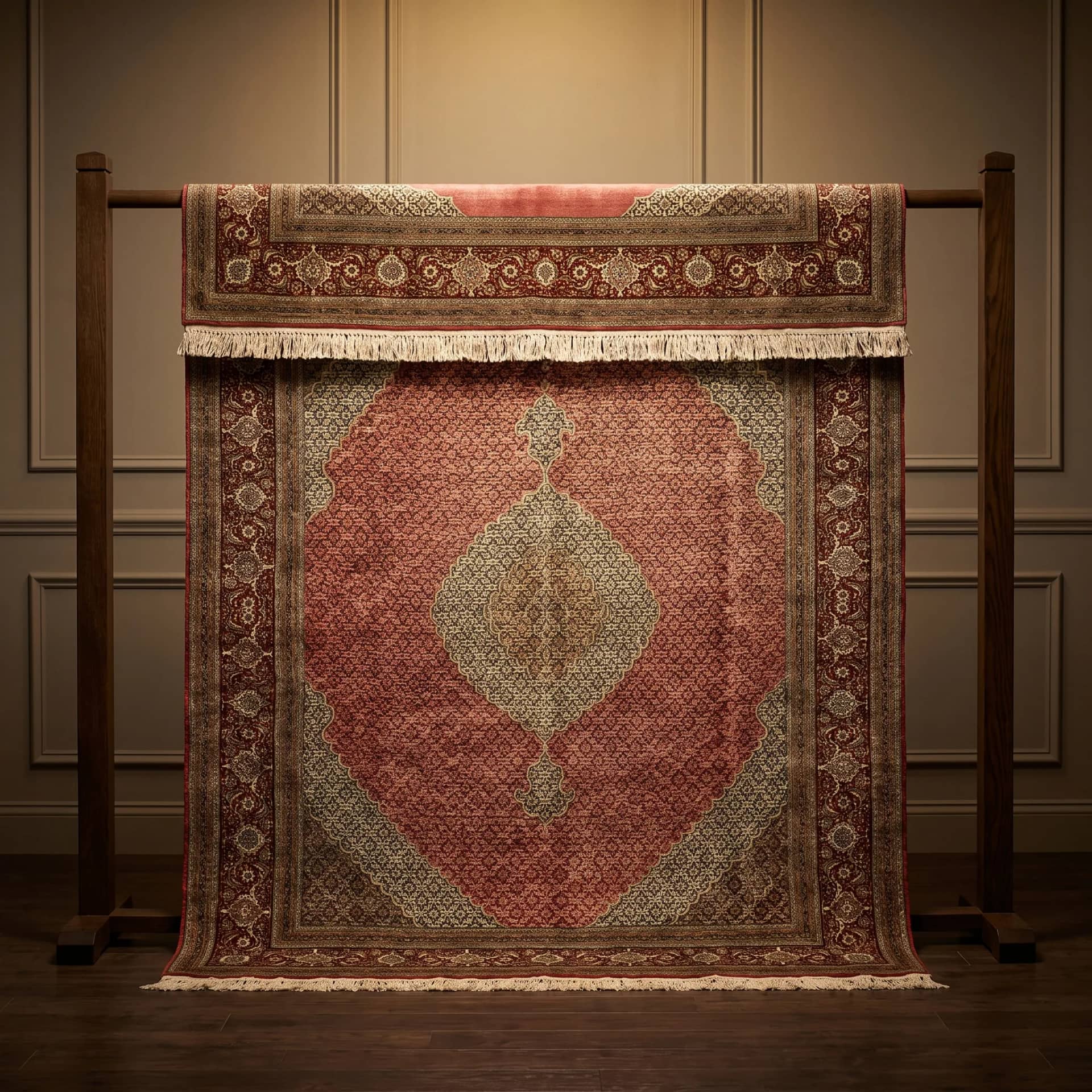
Tabriz Rugs
Tabriz is one of the oldest and most versatile of the great Persian weaving cities — the workshop tradition that helped launch the modern Persian carpet trade in the 19th century. Quality ranges enormously, from coarse commercial goods to silk-inlaid masterpieces, and Austin Auction Gallery has brought 30 Tabriz rugs to auction from Texas estates.
What it's worth
Knot density, age, and design determine where a Tabriz lands. Typical 20th-century room-size examples bring $400–$1,300 at our sales: an estate Persian Mashad wool Tabriz at 12'7" x 9'8" sold for $1,300, and a 6'5" x 10' example brought $1,100. Finer, tightly woven pieces — 50 raj and up, silk-inlaid, or signed by a known workshop — command significantly more in the national market. Worn but genuine antique Tabriz rugs still sell; condition discounts are real but not fatal.
Overview & history
Tabriz, in northwestern Persia, was the first great center of the carpet revival of the late 1800s, when its merchant houses organized workshop production for European and American export. That commercial history explains the category's range: a Tabriz can be anything from a sturdy, moderately woven room-size rug to a 400-knot-per-square-inch collector piece with silk highlights. Classic Tabriz designs include the central medallion with matching corner spandrels, all-over herati patterns, mehrab (prayer-niche) compositions, and pictorial rugs — the city wove everything. Palettes run to brick red, navy, and ivory, often softer than other Persian city rugs. The famous mahi (fish) herati design and fine 'Tabriz Khoi' and workshop-signed pieces sit at the top of the market.
Identifying & marks
Tabriz rugs use the symmetric (Turkish) knot — unusual among Persian city rugs — on a cotton foundation, with a firm, sometimes stiff handle. The weaver's hook (rather than fingers alone) leaves a distinctive even, slightly hard pile surface. Look for the medallion-and-spandrel or herati layouts and a controlled, formal drawing style. Fine pieces sometimes carry a woven workshop signature cartouche at one end — a signed Tabriz is always worth a specialist look.
Frequently asked
What is my Tabriz rug worth?
Typical 20th-century room-size Tabriz rugs bring $400–$1,300 at our sales. Finer grades — high knot counts, silk inlay, or a woven workshop signature — command real premiums nationally. Knot density is the key variable, and we can assess it from a sharp photo of the back.
What does a signature on my Tabriz rug mean?
Fine Tabriz workshops sometimes wove a signature cartouche into one end of the rug. A genuine workshop signature signals higher-grade production and is always worth documenting — bring it to our attention when you send photos.
Why does Tabriz quality vary so much?
Tabriz was the great commercial hub of the Persian carpet revival, producing everything from sturdy export goods to museum-grade masterpieces. That range is built into the name, which is why two Tabriz rugs of the same size can differ in value by a factor of ten. The weave fineness, not the label, sets the price.
What could your Tabriz Rugs bring at auction?
Our specialists provide free, no-obligation auction estimates. Send a few photos and we'll tell you what it could bring.