
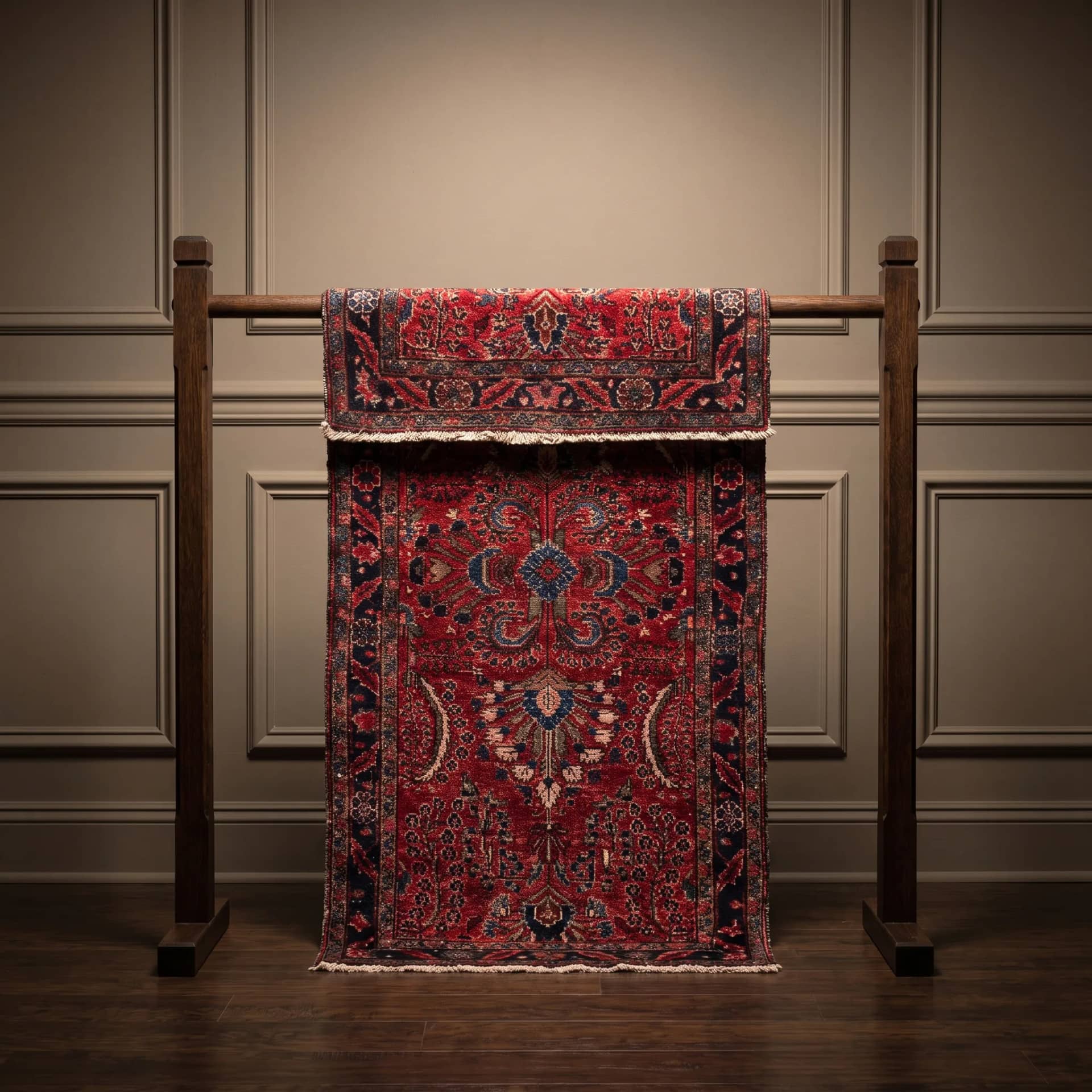
Sarouk Rugs
The Sarouk was the Persian rug America bought by the shipload: from the 1910s through the 1940s, the salmon-rose 'American Sarouk' with its detached floral sprays furnished countless formal living rooms. Those same rugs now surface in Texas estates, and Austin Auction Gallery has sold them at prices up to $1,300 — including a signed 14-footer.
What it's worth
American Sarouks in room sizes typically bring $400–$1,300 at our sales: a Persian Sarouk at 11'8" x 8'10" sold for $1,300, and a signed 14' x 9'8" example brought $900. Scatter sizes and runners bring $300–$600. Farahan Sarouks and unusually fine or early pieces command real premiums nationally. Painted pile (visible as color sitting on the fiber tips when you fold the pile open) is normal for the period — disclose it, but it does not kill value.
Overview & history
Saruq, a village near Arak in west-central Persia, wove finely knotted medallion rugs in the late 19th century that rank among the best Persian village work of their era. But the category's fame comes from the export boom that followed: American importers commissioned a specific look — a rose or salmon field scattered with detached floral bouquets, deep blue borders, thick lustrous pile — and even had rugs 'painted' (chemically stripped and re-dyed) in New York to hit the exact shade American taste demanded. That 'American Sarouk' is what most families own. Earlier 'Farahan Sarouks' (fine, ivory-ground, spacious medallion designs, pre-1915) are the collector grade and a different market altogether. Sarouk wool is excellent and the rugs wear beautifully, which keeps demand steady.
Identifying & marks
Classic American Sarouk markers: salmon-to-rose field, detached floral spray design (no connecting lattice), very thick pile, asymmetric knots on cotton, and a heavy, substantial handle. Fold the pile against the grain — if the fiber shafts are lighter than the tips, the rug was painted, a period-authentic practice. A woven signature cartouche adds interest and value. Farahan Sarouks show finer weave, ivory or cream grounds, and airier drawing.
Frequently asked
What is my Sarouk rug worth?
American Sarouks in room sizes bring $400–$1,300 at our sales; scatter sizes and runners bring $300–$600. Earlier Farahan Sarouks — finer, ivory-ground, pre-1915 — are the collector grade and worth notably more. Send photos and dimensions for a free assessment.
My Sarouk's color looks painted on. Is that damage?
No — it is period history. Many American Sarouks were 'painted' in New York in the 1920s–40s: chemically lightened, then re-dyed to the deep rose American taste demanded. It is a disclosed, expected trait of the era and does not prevent these rugs from selling well.
What makes a Sarouk an 'American Sarouk'?
The look was literally commissioned for the American market: salmon-rose fields scattered with detached floral bouquets, thick lustrous pile, and deep blue borders, woven roughly 1910–1950. It is the most common Sarouk in Texas estates and remains a dependable seller.
What could your Sarouk Rugs bring at auction?
Our specialists provide free, no-obligation auction estimates. Send a few photos and we'll tell you what it could bring.