
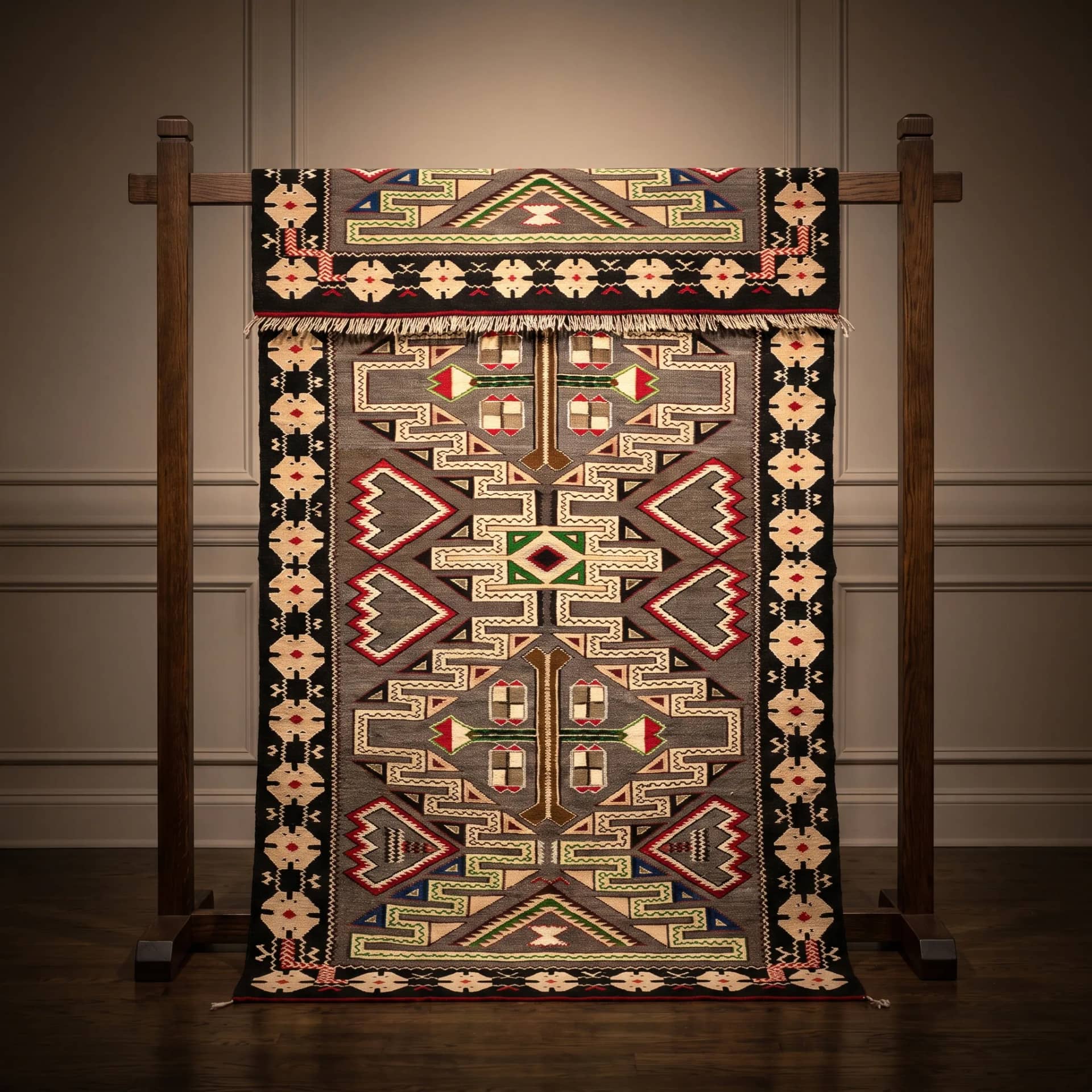
Navajo Rugs & Weavings
Navajo rugs are not oriental rugs at all — they are flat, tapestry-woven textiles from the American Southwest, and they are collected as Native American art rather than as floor coverings. Texas estates are full of them, from trading-post era regional weavings to mid-century pieces bought on family trips west, and Austin Auction Gallery has sold more than 30 Navajo weavings at auction.
What it's worth
Age, regional style, weave tightness, natural versus aniline dyes, and condition drive value. Common mid-20th-century weavings in average condition bring $200–$600. Early 20th-century pieces, pictorial Yei weavings, and tight regional work (especially Two Grey Hills) bring $800–$3,000 at our sales — a large 1920s Yei rug sold with us for $1,200 — and exceptional early examples can go much higher in the national market. Single pieces and whole Western collections are equally welcome.
Overview & history
Navajo weaving grew from Pueblo and Spanish traditions into one of the great American textile arts. The earliest chief's blankets and wearing blankets (pre-1880) are museum material worth five and six figures at specialty auctions. What surfaces in Texas estates is usually the trading-post era and later: regional styles developed around posts like Two Grey Hills (natural undyed browns, greys, and ivories in fine geometric work), Ganado (deep red grounds with crosses and diamonds), Crystal, and Wide Ruins, along with pictorial Yei and Yei-bi-chai weavings depicting ceremonial figures, and the electric 'Eye Dazzler' patterns of the late 19th century. Every genuine Navajo rug is woven on an upright loom in a continuous flat tapestry weave — no pile, no knots, and traditionally no fringe.
Identifying & marks
Genuine Navajo weavings show a continuous warp (the yarn runs unbroken top to bottom — look for 'lazy lines,' subtle diagonal joins where the weaver worked one section at a time), selvedge cords along the edges, and no knotted fringe. Mexican copies (Zapotec and others) are the most common confusion: they typically have a fringe formed by cut warp ends, coarser wool, and perfectly regular machine-spun yarn. A genuine piece feels dense and even, and the design is nearly identical on both faces.
Frequently asked
What is my Navajo rug worth?
Common mid-20th-century weavings bring $200–$600, while early 20th-century pieces, pictorial Yei weavings, and tight regional work like Two Grey Hills bring $800–$3,000 — a large 1920s Yei rug sold with us for $1,200. Age, regional style, weave tightness, and natural dyes set the price.
How can I tell a genuine Navajo rug from a Mexican copy?
Check the ends and edges: genuine Navajo weavings have continuous warps with no cut fringe, side selvedge cords, and subtle diagonal 'lazy lines' in the weave. Mexican (Zapotec-style) copies typically have knotted fringe from cut warp ends and perfectly uniform commercial yarn. It is the single most common question we settle — a photo of each end usually answers it.
Does it matter which trading post style my Navajo rug is?
Yes. Regional styles — Two Grey Hills (natural browns and greys), Ganado (deep red), Crystal, Wide Ruins, and pictorial Yei weavings — each have their own collector following and price behavior. Identifying the style correctly is a core part of cataloging a Navajo weaving for the right buyers.
What could your Navajo Rugs & Weavings bring at auction?
Our specialists provide free, no-obligation auction estimates. Send a few photos and we'll tell you what it could bring.