
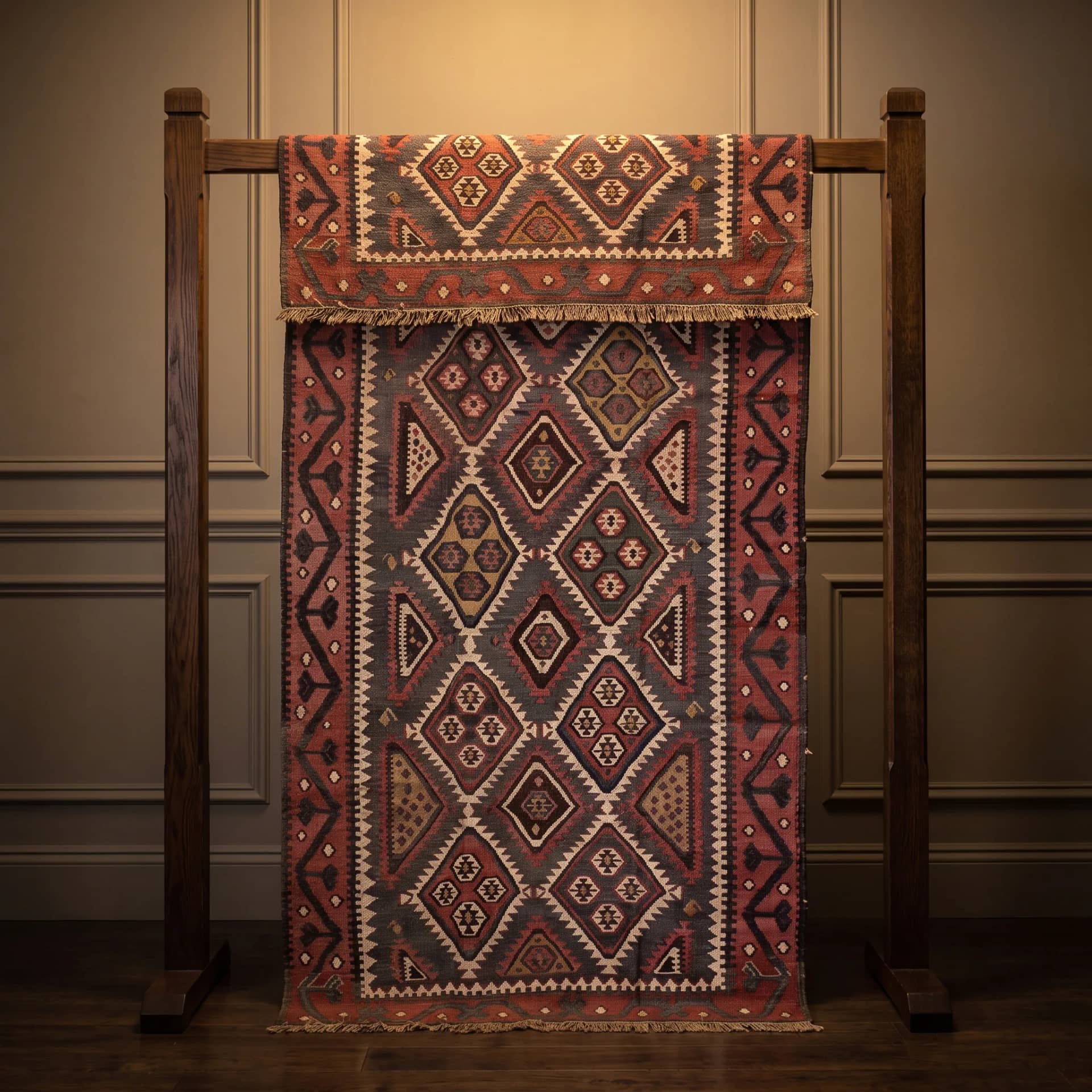
Kilim Rugs
Kilims are the flatwoven cousins of the pile carpet — no knots, no pile, just tightly woven wool in bold geometric color. Long treated as the affordable end of the rug trade, they have become a decorator staple, and Austin Auction Gallery has sold more than 50 kilim lots from Texas estates, from room-size Turkish pieces to runners and kilim-upholstered furniture.
What it's worth
Most estate kilims bring $200–$600 at auction, with size, age, color quality, and condition setting the price within that band. Larger and finer pieces do better: a 9'6" x 8' hand-woven kilim brought $550 and a 12'10" x 10'1" Turkish Bessarabian kilim brought $500 at our sales. Antique (pre-1920) Anatolian and Caucasian kilims with natural dyes can bring $1,000+ in the national market. Condition matters more than with pile rugs — slits and splits are harder to restore invisibly.
Our sold results
Auction results for Kilim Rugs
Showing 4 results
Auction Results
| Lot | Sold | Price realized |
|---|---|---|
| (3) SMALL HAND-WOVEN KILIM RUGS, LARGEST: 3'2" X 2'6" | Jan 2025 | $175 |
| (4) SMALL HAND-WOVEN KILIM & QUASHQAI RUGS, LARGEST: 2'11" X 2'3.5" | Jan 2025 | $100 |
| (2) VINTAGE KILIM FLAT WEAVE HAND TIED RUGS | $175 | |
| (2) VINTAGE KILIM FLAT WEAVE HAND TIED RUGS | $125 |
Overview & history
The kilim technique — slit-tapestry weaving, where the weft yarns carry the pattern and are packed down to completely hide the warp — is older than the knotted carpet itself and spans a huge geography: Anatolian Turkey, Persia (where flatweaves include soumak and verneh variants), the Caucasus, and Central Asia. Because kilims were traditionally woven for tribal and village use rather than export, their designs stayed boldly geometric — diamonds, hooked medallions, and banded compositions in saturated madder reds, indigos, and ochres. In today's market kilims trade primarily as decorative objects: flat, reversible, durable, and strong sellers when the color is good. Bessarabian-style floral kilims from the Balkans and larger room-size Anatolian pieces lead the category, and the look is popular enough that kilim fragments are routinely upholstered onto benches and ottomans — a kilim-covered bench sold with us for $1,800.
Identifying & marks
A kilim has no pile: the pattern is in the weave itself and the rug is essentially reversible, with tiny vertical slits where two colors meet (the signature of slit-tapestry technique). Wool on wool suggests tribal or village origin; cotton warps usually indicate later commercial production. Natural dyes show abrash — gentle banding within a single color — while chemically dyed 20th-century pieces are flatter and more uniform. Machine-made 'kilim-style' rugs betray themselves with a perfectly regular back and fused or glued edges.
Frequently asked
What is my kilim worth?
Most estate kilims bring $200–$600 at auction, with large room-size and Bessarabian floral examples at the top of that range and fine antique Anatolian or Caucasian pieces bringing $1,000+ nationally. Color quality and condition matter most — slits and splits are harder to restore than pile wear.
What is the difference between a kilim and a regular rug?
A kilim has no pile: the pattern is created by the weft threads themselves in a flat tapestry weave, making the rug thin, reversible, and light. Knotted-pile rugs have yarn tied onto the foundation, creating a plush surface. Both are handmade — they are simply different techniques with different markets.
Are kilims collectible or just decorative?
Both. Most 20th-century kilims trade as decorative furnishings, but antique tribal kilims with natural dyes — particularly Anatolian and Caucasian pieces — are seriously collected. Even fragments have value in the decorator trade for upholstery; a kilim-covered bench sold with us for $1,800.
What could your Kilim Rugs bring at auction?
Our specialists provide free, no-obligation auction estimates. Send a few photos and we'll tell you what it could bring.