
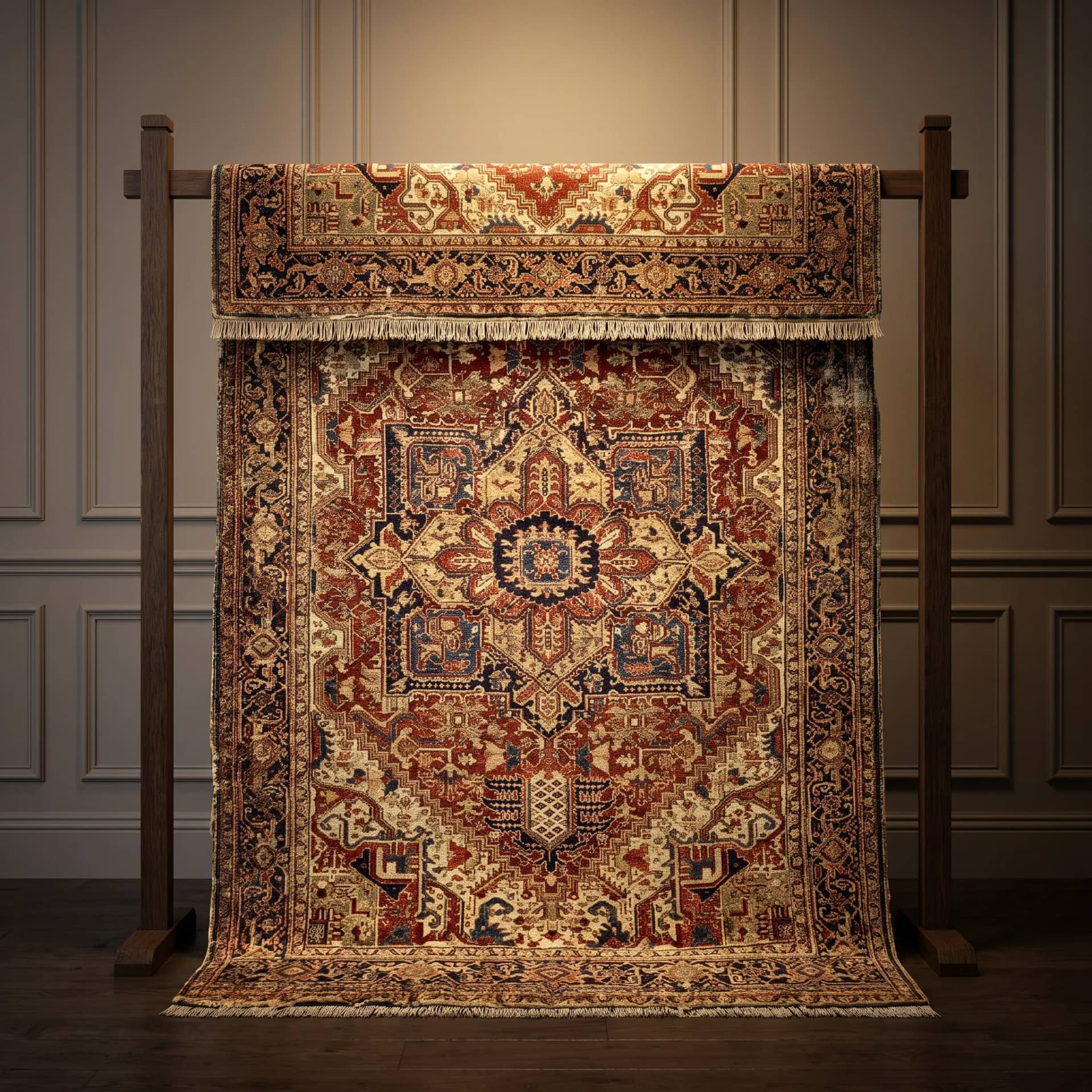
Heriz & Serapi Rugs
The Heriz — with its bold geometric medallion, brick-red field, and indestructible wool — is the great American favorite among Persian rugs, and 'Serapi' is the trade name for its finest 19th-century grade. Austin Auction Gallery has sold more than 20 Heriz and Serapi rugs, topped by a $4,250 estate Heriz in February 2026.
What it's worth
Typical 20th-century Heriz rugs in room sizes bring $800–$2,000 at auction. Antique and better examples go higher: our February 2026 sale saw an estate Heriz at 12'2" x 9'7" bring $4,250, a Serapi estate rug brought $3,250 in 2024, and a Mehrivan Heriz made $1,600. True Serapis with age, spacious drawing, and good color are the top of the category — nationally they can bring five figures in large sizes.
Overview & history
Woven in villages around the town of Heris in northwest Persia, the Heriz is instantly recognizable: an oversized, angular central medallion, rectilinear drawing (the district's weavers work from memory, not cartoons, which keeps the designs bold and geometric), and a palette anchored in brick red, terracotta, navy, and ivory. The wool — from mountain sheep, high in lanolin — is famously durable, which is why so many survive in usable condition. 'Serapi' is not a place but a grade: the American trade's name for the finer, earlier (roughly 1850–1910) Heriz production, with more spacious drawing, softer color, and finer weave. Room-size antique Heriz and Serapi rugs are perennial decorator targets, and good ones hold value better than almost any other Persian category.
Identifying & marks
Look for the angular medallion with 'anchor' pendants, rectilinear oak-leaf and vine drawing, and corner spandrels in contrasting color, all on a cotton foundation with a heavy, stiff handle. The back shows a coarse-to-medium symmetric knotting. Serapi indicators: softer, more varied color (abrash), more open field around a less dominant medallion, and finer weave than standard Heriz. Camel-hair-toned ground colors and squarish room sizes also point earlier.
Frequently asked
What is my Heriz rug worth?
Twentieth-century room-size Heriz rugs typically bring $800–$2,000, and antique examples more: we sold an estate Heriz at 12'2" x 9'7" for $4,250 in February 2026 and a Serapi for $3,250. Age, color, and spacious drawing push values up — fine large Serapis can bring five figures nationally.
What is the difference between a Heriz and a Serapi?
Serapi is a trade grade, not a separate place: the name American dealers gave the finer, earlier (roughly 1850–1910) Heriz production, with softer color, more open drawing, and finer weave. If your rug has age, varied abrash color, and a less dominant medallion, it may grade as Serapi — which materially raises the value.
Why are Heriz rugs so durable?
The mountain sheep of the Heriz district produce wool unusually high in lanolin, and the rugs are coarsely but very solidly knotted on cotton. They were built to survive generations of use — which is why so many good ones still come out of estates in sellable condition.
What could your Heriz & Serapi Rugs bring at auction?
Our specialists provide free, no-obligation auction estimates. Send a few photos and we'll tell you what it could bring.