
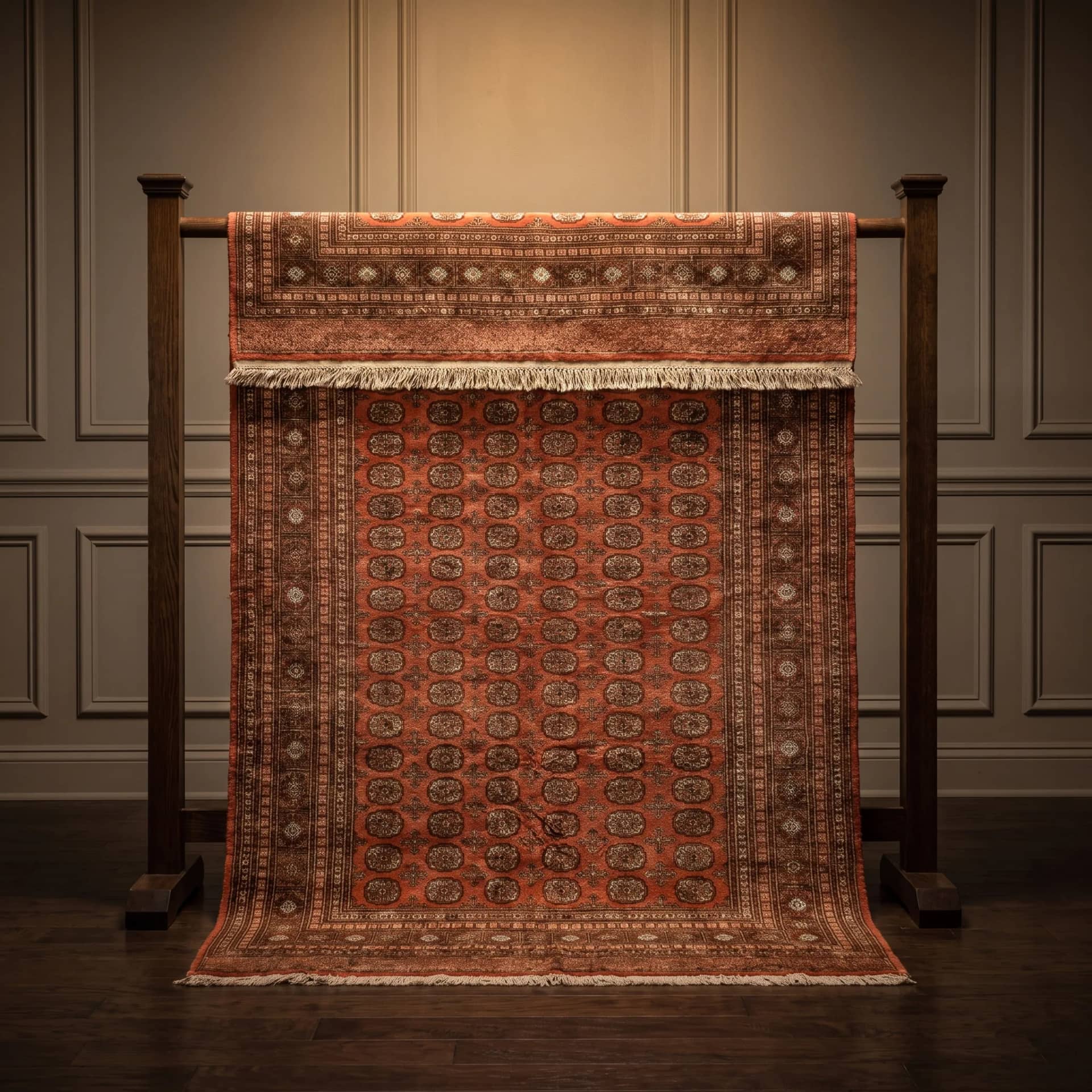
Bokhara Rugs
The Bokhara — named for the Silk Road trading city where Turkmen tribal rugs came to market — is one of the most recognizable rug designs in the world: rows of repeating oval güls on a deep red ground. Most examples in Texas estates are well-made 20th-century Pakistani and Afghan production, and Austin Auction Gallery prices them honestly and sells them briskly.
What it's worth
Most 20th-century Bokhara rugs and runners bring $300–$500 at auction: our recent results include an estate Bokhara runner at $450, an Afghan Bokhara runner at $425, and Pakistani room-size examples at $375. Genuine antique Turkmen tribal weavings are another matter entirely and can bring $1,000 to five figures — if your 'Bokhara' has an irregular, all-wool handle, asymmetric güls, and real age, have it looked at before assuming it is modern.
Overview & history
True antique 'Bokharas' are Turkmen tribal weavings — Tekke, Salor, and Yomud work from Central Asia, where each tribe's gül (the octagonal medallion repeated in rows) functioned almost as a heraldic signature. Those 19th-century tribal pieces are a serious collector field. The rugs most families own, though, are 20th-century interpretations woven in Pakistan (often labeled 'Pak-Bokhara') and Afghanistan: finely knotted, soft, glossy wool, in the classic deep red, and excellent value as furnishing rugs. The design's popularity means quality varies — the best Pakistani examples are densely woven with a silky handle, while budget versions are coarser and chemically washed for shine. Runners and small scatter sizes are common and sell reliably.
Identifying & marks
Count the güls: genuine Turkmen work shows subtle irregularity in the rows and tribal variation in the gül form, on an all-wool foundation. Pakistani production is precise and uniform, usually on cotton, with a soft, lustrous (sometimes lacquer-shiny) finish. Afghan pieces tend to be darker — deep oxblood to brown-red. Fringe and selvedge finishing is also a clue: tribal pieces often have flat-woven skirt ends with banded decoration.
Frequently asked
What is my Bokhara rug worth?
Most 20th-century Bokharas — typically Pakistani or Afghan production — bring $300–$500 at auction, with runners in the same range. Genuine antique Turkmen tribal weavings are a different market and can bring $1,000 to five figures, so an old, all-wool, irregular example deserves a specialist look.
Is my Bokhara Persian?
Usually not. The design descends from Turkmen tribal weaving in Central Asia, and most modern examples were woven in Pakistan or Afghanistan. 'Bokhara' names the pattern — rows of repeating oval güls on a red ground — rather than a single place of origin.
How can I tell an antique Turkmen piece from a modern Bokhara?
Antique tribal work shows an all-wool foundation, subtle irregularities in the gül rows, deep natural reds, and often flat-woven banded ends. Pakistani production is precise and uniform on cotton with a soft, glossy finish. The difference matters — it can be a tenfold value gap.
What could your Bokhara Rugs bring at auction?
Our specialists provide free, no-obligation auction estimates. Send a few photos and we'll tell you what it could bring.