
Stickley
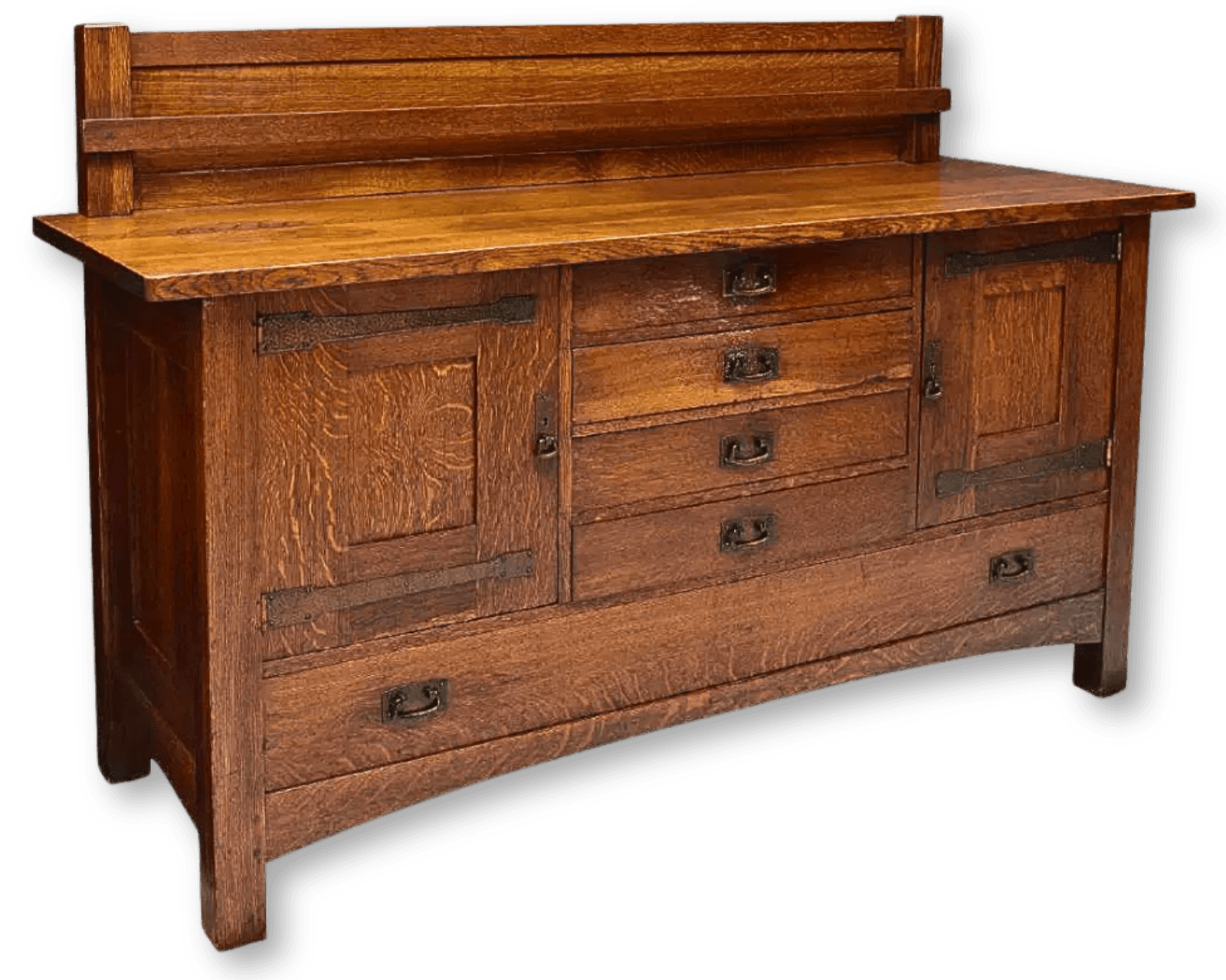
Stickley is the defining name in American Arts & Crafts furniture — a family of craftsmen who produced the quartersawn oak, mortise-and-tenon, leather-and-tack furniture that became the visual language of the American Craftsman movement. Gustav Stickley's 'Craftsman' pieces are the most collected; L. & J.G. Stickley pieces are a strong second market. The company still operates today, making authentication and dating critical. Austin Auction Gallery sells and appraises Stickley furniture.
What it's worth
Original Gustav Stickley 'Craftsman' pieces are the most valuable. A Gustav Morris chair (the reclining armchair that is his most iconic form) in original finish with original leather brings $2,000–$8,000. Large Gustav bookcases, sideboards, and library tables bring $2,000–$15,000. Exceptional or rare Gustav pieces — the large settle, the server with plate rail, documented early pieces — can bring $5,000–$30,000+. L. & J.G. Stickley period pieces bring 30–50% less than comparable Gustav examples. Side chairs bring $300–$1,200 for original period pieces; arm chairs $600–$2,500. Small tables and tabourets bring $200–$800. Original finish and original upholstery (or period-appropriate replacement) are critical — refinished or re-upholstered pieces bring significantly less. Modern L. & J.G. reproductions bring $200–$1,000 depending on the specific piece.
Our sold results
Auction results for Stickley
Showing 3 results
Auction Results
| Lot | Sold | Price realized |
|---|---|---|
| GUSTAV STICKLEY (1858-1942) OAK FLAT-ARM 'MORRIS' CHAIR, MODEL 332 | Mar 2026 | $1,200 |
| GUSTAV STICKLEY (1858-1942) OAK FLAT-ARM 'MORRIS' CHAIR, MODEL 332 | Oct 2025 | $2,750 |
| (2) LEOPOLD STICKLEY (1869-1957) AMERICAN CHERRYWOOD SIDE TABLES | Jun 2024 | $425 |
Overview & history
The Stickley name in American furniture encompasses several related but distinct companies, all founded by members of the same Stickley family in the first decade of the 20th century. Understanding which Stickley made a piece is the first step in determining its value. Gustav Stickley (1858–1942) is the most important figure — the designer and manufacturer who, through his Craftsman Workshops in Eastwood, New York (established 1900), created the furniture that defined American Arts & Crafts. Inspired by the English Arts & Crafts movement of William Morris and John Ruskin, and by his own trips to Europe in 1898, Gustav developed a furniture vocabulary of radical simplicity: quartersawn white oak (chosen for its ray-fleck figure and resistance to warping), exposed through-tenons held by wooden keys or wedges, hand-hammered copper or iron hardware, and original finishes of fumed ammonia or oil-and-wax that gave the oak its characteristic warm brown tone. He published 'The Craftsman' magazine from 1901 to 1916, promoting not just his furniture but an entire philosophy of simple, honest living that made him the most influential tastemaker of the American Arts & Crafts era. His brothers also manufactured Arts & Crafts furniture. L. & J.G. Stickley (Leopold and John George Stickley, founded in Fayetteville, New York, 1902) produced very similar furniture of comparable quality and is still in operation today — the longest continuously operating American furniture manufacturer. Stickley Brothers (Albert and Charles Stickley, Grand Rapids, Michigan) produced a slightly more commercial version of the style under the 'Quaint Furniture' brand. Distinguishing between these companies requires attention to their different marks. The Arts & Crafts revival of the 1980s–1990s brought both a renewed collector interest in original period pieces and a substantial reproduction market. L. & J.G. Stickley began producing 'reproduction' Arts & Crafts pieces using modern methods — these are quality furniture but worth significantly less than original period pieces.
Identifying & marks
Gustav Stickley used several marks across his production years. The earliest pieces (c. 1901–1903) use a joiner's compass enclosing the words 'Als ik kan' (Flemish for 'as best I can,' borrowed from Van Eyck) with 'Stickley' below. From c. 1903 onward, he used a red decal or burned-in mark incorporating the compass and the words 'Craftsman' or 'Stickley.' After 1912, the mark often reads 'Gustav Stickley' in block letters. The mark is typically found under chairs, inside drawers, or on the back of case goods — look carefully, as marks are often faint or partially worn. L. & J.G. Stickley used a red decal reading 'The Work of L. & J.G. Stickley' in a clamp device, or a paper label. Stickley Brothers used a 'Quaint Furniture' tag or metal label. Unmarked pieces are attributed by construction details: through-tenons with wooden keys, quartersawn oak, hand-hammered copper hardware, and original fumed or oil-finished surfaces all support Arts & Crafts period attribution.
Frequently asked
What could my Stickley bring at auction?
Original Gustav Stickley 'Craftsman' pieces are the most valuable. A Gustav Morris chair (the reclining armchair that is his most iconic form) in original finish with original leather brings $2,000–$8,000. Large Gustav bookcases, sideboards, and library tables bring $2,000–$15,000. Exceptional or rare Gustav pieces — the large settle, the server with plate rail, documented early pieces — can bring $5,000–$30,000+. L. & J.G. Stickley period pieces bring 30–50% less than comparable Gustav examples. Side chairs bring $300–$1,200 for original period pieces; arm chairs $600–$2,500. Small tables and tabourets bring $200–$800. Original finish and original upholstery (or period-appropriate replacement) are critical — refinished or re-upholstered pieces bring significantly less. Modern L. & J.G. reproductions bring $200–$1,000 depending on the specific piece.
How do I identify Stickley?
Gustav Stickley used several marks across his production years. The earliest pieces (c. 1901–1903) use a joiner's compass enclosing the words 'Als ik kan' (Flemish for 'as best I can,' borrowed from Van Eyck) with 'Stickley' below. From c. 1903 onward, he used a red decal or burned-in mark incorporating the compass and the words 'Craftsman' or 'Stickley.' After 1912, the mark often reads 'Gustav Stickley' in block letters. The mark is typically found under chairs, inside drawers, or on the back of case goods — look carefully, as marks are often faint or partially worn. L. & J.G. Stickley used a red decal reading 'The Work of L. & J.G. Stickley' in a clamp device, or a paper label. Stickley Brothers used a 'Quaint Furniture' tag or metal label. Unmarked pieces are attributed by construction details: through-tenons with wooden keys, quartersawn oak, hand-hammered copper hardware, and original fumed or oil-finished surfaces all support Arts & Crafts period attribution.
How do I sell my Stickley?
Austin Auction Gallery offers free, no-obligation appraisals. Send a few photos and our specialists will tell you what it could bring at auction, then handle every step from cataloging through the sale.
What could your Stickley bring at auction?
Our specialists provide free, no-obligation auction estimates. Send a few photos and we'll tell you what it could bring.