
Napoleon III
Napoleon III furniture — produced during France's Second Empire under Napoleon III and Empress Eugénie — is the most eclectic and exuberant of the 19th-century French styles: an ambitious revival of all the earlier French royal styles simultaneously, in ebonized wood, lacquer, Boulle marquetry, ormolu, and porcelain plaques. The style furnished the grand hôtels particuliers and country houses of the Second Empire bourgeoisie, and it fills Texas estate sales to this day. Austin Auction Gallery has sold over 275 Napoleon III period lots.
What it's worth
Napoleon III vitrine cabinets in ebonized wood with ormolu banding typically bring $600–$3,000 depending on size, condition, and the quality of any porcelain plaques. Boulle-work pieces — tables, cabinets, mantel clock sets ('garnitures') — bring $800–$5,000+ depending on scale and condition of the Boulle marquetry. Pairs of torchères or pedestals bring $500–$3,000 per pair. Bronze doré and ormolu objects from the period bring $400–$4,000 depending on quality and subject. Mantel clock garnitures (clock with two flanking urns or candelabra) bring $400–$2,500 for standard quality; exceptional examples by named retailers bring more. The condition of Boulle marquetry is critical: lifting or replaced tortoiseshell significantly reduces value.
Our sold results
Auction results for Napoleon III
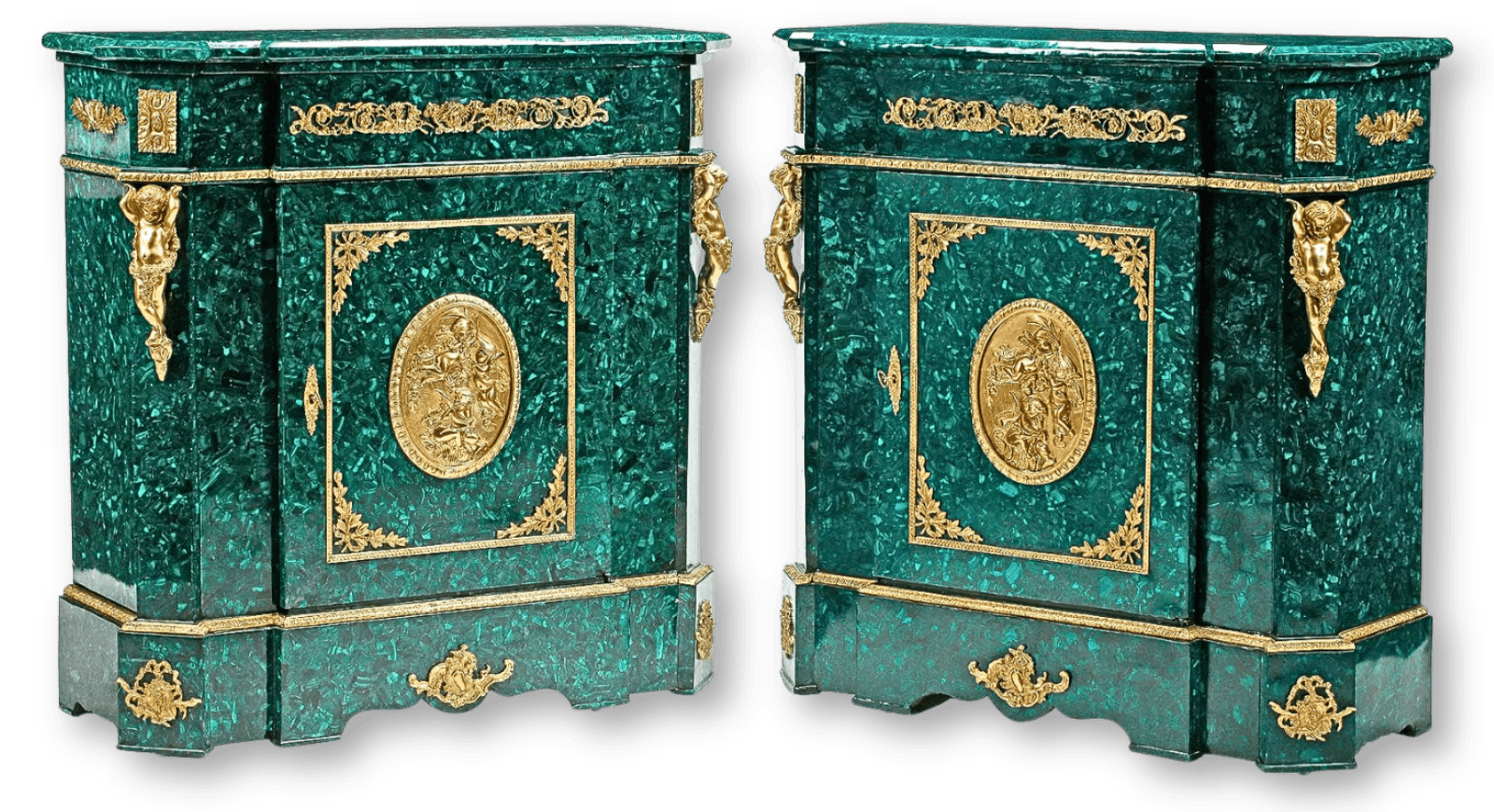
 (2) HENRY DASSON ORMOLU-MOUNTED BOULLE WORK CABINETS$38,000Jan 2020(2) NAPOLEON III STYLE ORMOLU-MOUNTED & MALACHITE-VENEERED CABINETS$12,000Feb 2026
 NAPOLEON III PERIOD ORMOLU-MOUNTED & STONE-TOP EBONIZED CABINET$5,000May 2026
Showing 90 results
Auction Results
Overview & history
Napoleon III and Empress Eugénie presided over a court that looked backward for inspiration: to the ancien régime French royal styles of Louis XIV, Louis XV, and Louis XVI, and to the fashionable Japonisme and Orientalism of the 1860s. The result was a furniture production of enormous energy and technical ambition — the great Paris workshops employed the full range of 19th-century cabinetmaking skill to produce revivals of all the earlier styles, often with more ornament than the originals. The Napoleon III revival of Boulle marquetry — the tortoiseshell-and-brass inlay technique developed under Louis XIV — was the most technically demanding and the most prestigious. Napoleon III Boulle cabinets, tables, and mantel clocks, produced in quantity for the luxury market, are among the most recognizable furniture of the period. Ebonized wood — wood stained to resemble ebony — provided a dramatic ground for ormolu mounts and porcelain plaques, and vitrine display cabinets in ebonized wood with ormolu banding and Sèvres-style porcelain plaques are the most common Napoleon III form in the American market. Lacquer panels from Japan and China (or French-made imitations in the Vernis Martin tradition) were incorporated into cabinet doors; bronze doré was used lavishly for mounts, frames, and centerpiece objects. In Texas estates, Napoleon III pieces appear as mantel clocks (often retailed by Parisian shops), vitrine display cabinets, étagères, side tables, and the occasional large piece — an ebonized and ormolu salon suite, a Boulle-work cabinet — that was the centerpiece of a collecting room.
Identifying & marks
Napoleon III pieces are identified by their characteristic combination of ebonized or dark-stained wood with brass or ormolu mounts, and by their eclectic revival ornament. Boulle marquetry should be examined carefully: Napoleon III examples use thinner-cut tortoiseshell than genuine Louis XIV period pieces, though quality varies widely. Porcelain plaques on vitrines and tables may carry Sèvres factory marks (interlocked Ls) with date letters, but many plaques are Sèvres-style (made in the Sèvres manner by other factories) rather than genuine Sèvres. Major Paris retailers — Beurdeley, Barbedienne, Millet — sometimes signed or labeled their pieces. Cast ormolu mounts on Napoleon III pieces are of generally high quality; look for fine detail in the casting and warm fire-gilding on quality examples.
Frequently asked
What could my Napoleon III bring at auction?
Napoleon III vitrine cabinets in ebonized wood with ormolu banding typically bring $600–$3,000 depending on size, condition, and the quality of any porcelain plaques. Boulle-work pieces — tables, cabinets, mantel clock sets ('garnitures') — bring $800–$5,000+ depending on scale and condition of the Boulle marquetry. Pairs of torchères or pedestals bring $500–$3,000 per pair. Bronze doré and ormolu objects from the period bring $400–$4,000 depending on quality and subject. Mantel clock garnitures (clock with two flanking urns or candelabra) bring $400–$2,500 for standard quality; exceptional examples by named retailers bring more. The condition of Boulle marquetry is critical: lifting or replaced tortoiseshell significantly reduces value.
How do I identify Napoleon III?
Napoleon III pieces are identified by their characteristic combination of ebonized or dark-stained wood with brass or ormolu mounts, and by their eclectic revival ornament. Boulle marquetry should be examined carefully: Napoleon III examples use thinner-cut tortoiseshell than genuine Louis XIV period pieces, though quality varies widely. Porcelain plaques on vitrines and tables may carry Sèvres factory marks (interlocked Ls) with date letters, but many plaques are Sèvres-style (made in the Sèvres manner by other factories) rather than genuine Sèvres. Major Paris retailers — Beurdeley, Barbedienne, Millet — sometimes signed or labeled their pieces. Cast ormolu mounts on Napoleon III pieces are of generally high quality; look for fine detail in the casting and warm fire-gilding on quality examples.
How do I sell my Napoleon III?
Austin Auction Gallery offers free, no-obligation appraisals. Send a few photos and our specialists will tell you what it could bring at auction, then handle every step from cataloging through the sale.
What could your Napoleon III bring at auction?
Our specialists provide free, no-obligation auction estimates. Send a few photos and we'll tell you what it could bring.