
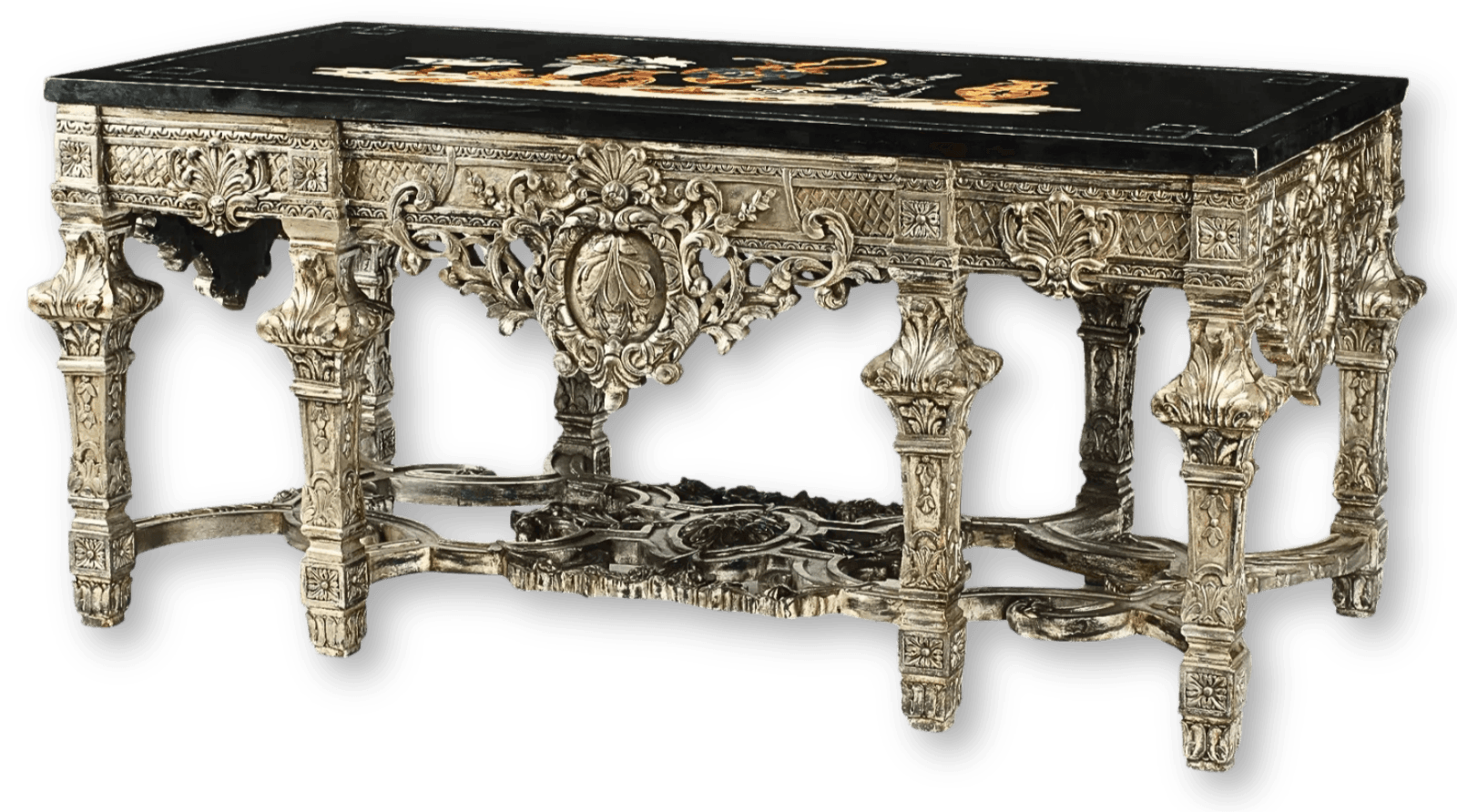
Louis XIV
Louis XIV furniture is the most monumental and architecturally grand of the French styles — massive carved and gilded forms, Boulle marquetry of tortoiseshell and brass, and the absolute authority of the Sun King's court expressed in wood, marble, and gilded bronze. True period pieces are rare; what appears in Texas estates is mainly quality 19th and 20th-century reproduction furniture in the Louis XIV manner, along with the occasional genuine period piece from a collection with European roots. Austin Auction Gallery has sold over 125 Louis XIV and Louis XIV-style lots.
What it's worth
Quality Napoleon III-period Boulle revival pieces — cabinets, tables, clocks — bring $800–$5,000 depending on size, condition, and quality of the Boulle work. Carved and gilded console tables in the Louis XIV manner bring $500–$3,000 per pair; single tables bring less. Large carved and gilded armoires in the Louis XIV style bring $1,500–$6,000. Genuine 17th-century Louis XIV period pieces are extremely rare and would bring $10,000–$100,000+ at specialist auction, with documented pieces by Boulle himself among the most valuable French furniture in existence. The condition of Boulle marquetry is critical: lifting, repaired, or replaced tortoiseshell and brass significantly reduces value.
Our sold results
Auction results for Louis XIV
Showing 44 results
Auction Results
Overview & history
Louis XIV furniture was created to furnish Versailles and express the absolute power of the French monarchy — and it looks the part. The style developed under the direction of Charles Le Brun, who oversaw the Manufacture Royale des Meubles de la Couronne (the royal furniture workshop established at the Gobelins tapestry manufactory), and its defining characteristics are scale, architectural rigidity, and an overwhelming richness of ornament. Straight legs ending in block feet or carved bun feet, massive cornices and pediments, carved and gilded gesso over a pine or limewood core, and the dark drama of Boulle marquetry — the technique of inlaying tortoiseshell with brass and pewter in elaborate arabesque patterns — are the visual language of the style. André-Charles Boulle, the royal ébéniste appointed by Louis XIV, gave his name to this marquetry technique that became the most prestigious cabinetmaking method in Europe. 'Première partie' Boulle has a tortoiseshell ground with brass inlay; 'contre-partie' reverses the scheme to a brass ground with tortoiseshell inlay. Both versions were produced simultaneously from the same cut sheets of material. Boulle furniture was revived with extraordinary enthusiasm in the Napoleon III period, and the majority of Boulle-work pieces on the market date from this later 19th-century revival rather than from the original Louis XIV period. In Texas estates, Louis XIV-style furniture appears most often as imposing carved and gilded console tables and pier mirrors, large cabinet-on-stand forms, and Boulle-work pieces of the Napoleon III revival.
Identifying & marks
Distinguishing genuine Louis XIV period pieces from the extensive 19th-century revival requires specialist examination. Genuine period Boulle work uses natural tortoiseshell (warm, irregular, with natural variation in the shell); 19th-century revival pieces often use thinner-cut tortoiseshell or pressed imitation. Oak is the carcase wood of genuine 17th-century pieces; 19th-century revival pieces often use pine or walnut. Original ormolu on genuine period pieces is of exceptional quality — fire-gilded (mercury gilding) bronze with fine hand-chasing. The scale and weight of genuine Louis XIV case goods is substantial; major pieces were made to furnish palace-scale rooms. Carved and gilded pieces should show genuine carved wood beneath the gesso, not applied ornament over a simple carcass.
Frequently asked
What could my Louis XIV bring at auction?
Quality Napoleon III-period Boulle revival pieces — cabinets, tables, clocks — bring $800–$5,000 depending on size, condition, and quality of the Boulle work. Carved and gilded console tables in the Louis XIV manner bring $500–$3,000 per pair; single tables bring less. Large carved and gilded armoires in the Louis XIV style bring $1,500–$6,000. Genuine 17th-century Louis XIV period pieces are extremely rare and would bring $10,000–$100,000+ at specialist auction, with documented pieces by Boulle himself among the most valuable French furniture in existence. The condition of Boulle marquetry is critical: lifting, repaired, or replaced tortoiseshell and brass significantly reduces value.
How do I identify Louis XIV?
Distinguishing genuine Louis XIV period pieces from the extensive 19th-century revival requires specialist examination. Genuine period Boulle work uses natural tortoiseshell (warm, irregular, with natural variation in the shell); 19th-century revival pieces often use thinner-cut tortoiseshell or pressed imitation. Oak is the carcase wood of genuine 17th-century pieces; 19th-century revival pieces often use pine or walnut. Original ormolu on genuine period pieces is of exceptional quality — fire-gilded (mercury gilding) bronze with fine hand-chasing. The scale and weight of genuine Louis XIV case goods is substantial; major pieces were made to furnish palace-scale rooms. Carved and gilded pieces should show genuine carved wood beneath the gesso, not applied ornament over a simple carcass.
How do I sell my Louis XIV?
Austin Auction Gallery offers free, no-obligation appraisals. Send a few photos and our specialists will tell you what it could bring at auction, then handle every step from cataloging through the sale.
What could your Louis XIV bring at auction?
Our specialists provide free, no-obligation auction estimates. Send a few photos and we'll tell you what it could bring.