
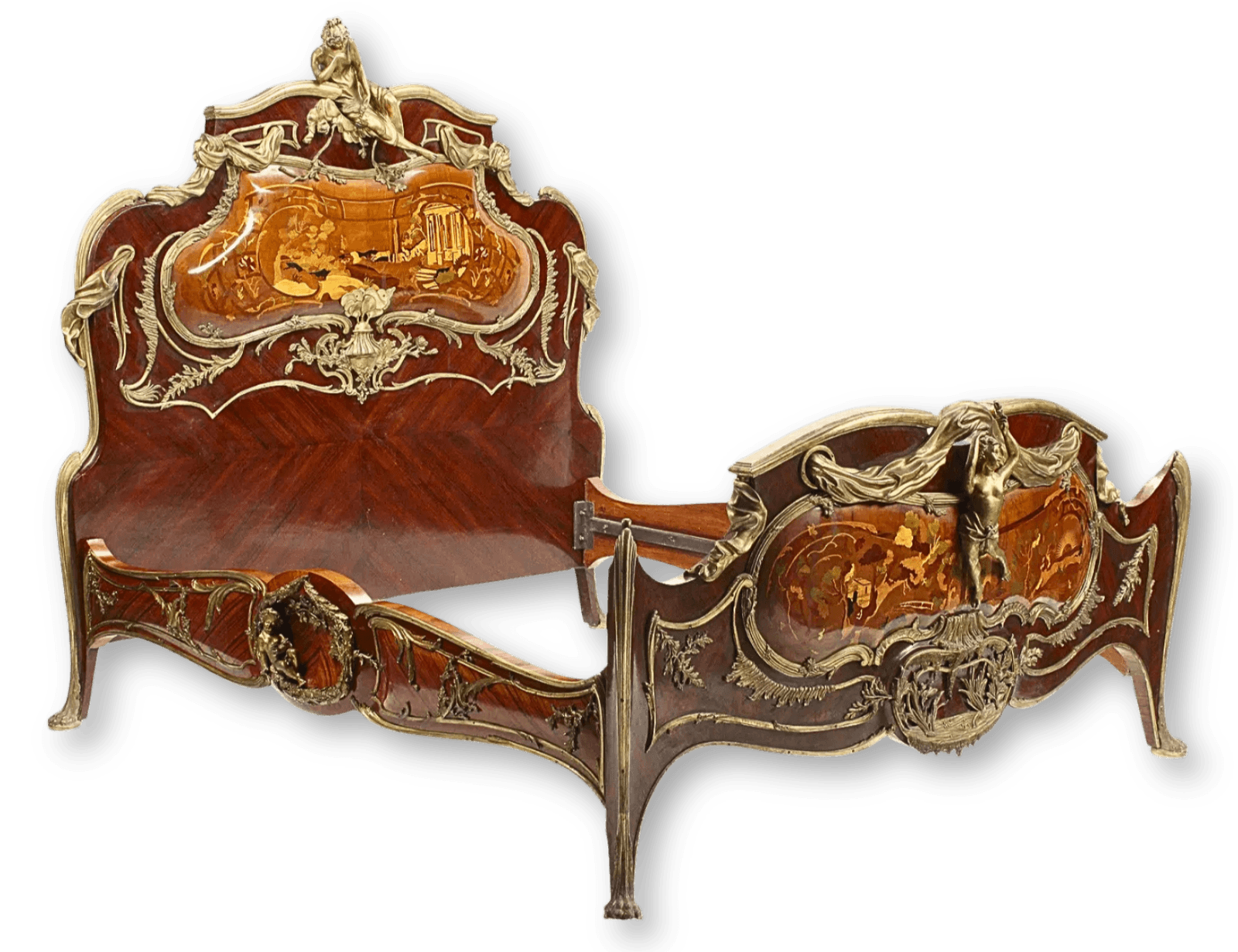
François Linke
François Linke (1855–1946) was the greatest ébéniste of the Belle Époque — a Czech-born cabinetmaker who came to Paris in the 1870s and built a workshop on the Place Vendôme that produced some of the most elaborate and technically accomplished furniture ever made. His Louis XV and Louis XVI revival pieces, with sculptural ormolu mounts by Léon Messagé and marquetry of extraordinary refinement, are among the most actively collected French antiques in the world. Austin Auction Gallery has sold verified Linke lots including pieces with Sotheby's provenance.
What it's worth
François Linke furniture spans an enormous range depending on size, form, and the elaborateness of the ormolu. Small pieces — bedside cabinets, bijouterie tables, smaller vitrine cabinets — bearing his stamp bring $5,000–$20,000 at auction. Mid-range pieces — commodes, bureau plats, vitrine cabinets of standard size, pairs of card tables — bring $15,000–$80,000. Large exhibition-quality pieces — monumental salon cabinets, elaborate commodes with figural sculpture, documented pieces with major auction provenance — bring $80,000–$500,000+. The pair of card tables and the Sotheby's-provenance tambour commode from Austin Auction Gallery's past sales represent the higher end of this range. Attribution ('attributed to' or 'in the manner of') rather than a confirmed stamp reduces value by 50–70%. Original unstruck or unpolished ormolu in warm fire-gilt condition is critical to value; replated or polished mounts reduce value significantly.
Our sold results
Auction results for François Linke
 FRANCOIS LINKE CASED ERARD GRAND PIANO, C. 1895$42,000Apr 2017
 ERARD CONCERT GRAND PIANO ATTRIB. FRANCOIS LINKE$29,000May 2017
 FRANCOIS LINKE ORMOLU-MOUNTED VITRINE CABINET$18,000Sep 2023
Showing 6 results
Auction Results
| Lot | Sold | Price realized |
|---|---|---|
| (PAIR) FRANCOIS LINKE LOUIS XV STYLE ORMOLU-MOUNTED CARD TABLES | Oct 2024 | $9,000 |
| FRANCOIS LINKE LOUIS XV STYLE ORMOLU-MOUNTED PARQUETRY BUREAU PLAT | Oct 2024 | $4,750 |
| UNIQUE FRANCOIS LINKE MARBLE-TOP MAHOGANY TAMBOUR-DOOR COMMODE, SOTHEBYS | Oct 2024 | $1,900 |
| FRANCOIS LINKE LOUIS XV STYLE ORMOLU-MOUNTED MARQUETRY CABINET | Oct 2024 | $1,800 |
| FRANCOIS LINKE ORMOLU-MOUNTED VITRINE CABINET | Sep 2023 | $18,000 |
| FRANCOIS LINKE (ATTRIB) ORMOLU BEDSIDE CABINET | Sep 2023 | $3,000 |
Overview & history
François Linke was born in 1855 in Pankrác, near Prague, in what was then the Austrian Empire. He trained as a cabinetmaker in central Europe before arriving in Paris around 1875, and by 1881 he had established his own atelier, eventually settling at a workshop and showroom at the Place Vendôme address that would become synonymous with the finest Belle Époque furniture. Over the next six decades he built a reputation as the premier maker of luxury revival furniture for an international clientele of European aristocrats, American industrialists, and South American collectors — the same gilded-age fortunes that were furnishing the great houses of the late 19th and early 20th centuries. Linke's genius lay in his ability to take the forms of the great 18th-century French royal styles — particularly Louis XV and, to a lesser extent, Louis XVI — and reinterpret them with a Victorian-era lavishness that went beyond even the originals. Where an 18th-century Louis XV commode might have ormolu mounts of restrained elegance, a Linke commode might erupt into full figural sculpture: ormolu satyrs gripping the corners, a massive cartouche mount on the front panel featuring a goddess or allegorical figure in high relief, feet in the form of claw-and-ball gripped by bronze animal paws. These mounts were not stock hardware but original sculptures, modeled by his close collaborator Léon Messagé — a trained sculptor whose work gave Linke's pieces their characteristic dramatic energy. The marquetry and parquetry on Linke's surfaces is equally remarkable. He used tulipwood, kingwood, satinwood, harewood, and other period-appropriate veneers in geometric parquetry patterns and occasionally in floral marquetry, applied over an oak carcase using traditional 18th-century techniques. The combination of this technical fidelity to period construction with the sculptural excess of his mounts gives Linke pieces their distinctive character: they are at once the most authentic and the most extravagant furniture of their era. His exhibition pieces — made for the major Paris Expositions Universelles, particularly the 1900 Exposition where he won a gold medal — are the pinnacle of his production. The 1900 pieces, including his monumental bureau de cabinet now in museum collections, were designed to demonstrate the full range of his workshop's skill and represent the most valuable Linke work in existence. Beyond the exhibition pieces, he produced a range of furniture from his largest salon commodes and vitrine cabinets down to smaller bijouterie tables and bedside cabinets, all bearing his stamp and all produced with the same attention to quality that made his name. Linke pieces appear in Texas and Louisiana estates because his primary market during his working life (1881–1940s) was exactly the wealthy clientele that was building and furnishing grand homes in the American South and Southwest — oil fortunes, cotton fortunes, and cattle fortunes that looked to French furniture as the ultimate statement of taste and prosperity.
Identifying & marks
Linke stamped his pieces with his name — 'F. LINKE' — typically in a rectangular brass cartouche applied to the back of the piece, inside a drawer, or on the underside. The stamp appears in a neat serif capital letterform and is usually accompanied by his Paris address. On pieces where the stamp is absent but attribution is claimed, the quality of the ormolu mounts is the primary evidence: Linke's mounts are of an immediately recognizable quality, with fine hand-chasing over high-quality casting, and the sculptural figures are identifiable by Messagé's distinctive modeling style — a sinuous, somewhat mannerist figural quality that differs from the more restrained ormolu of contemporary makers. The marquetry and parquetry follow 18th-century techniques: thick-cut veneers, hand-laid over an oak carcase, with hand-cut dovetails on the drawers. The overall weight and density of a genuine Linke piece is substantial — the oak carcases are heavy and the ormolu is solid cast bronze, not hollow. Be aware that 'in the manner of Linke' or 'Linke style' pieces were produced by other Paris workshops and by later 20th-century manufacturers. The stamp is the definitive authenticator; attributed pieces without a stamp should be examined by a specialist before purchase.
Frequently asked
What could my François Linke bring at auction?
François Linke furniture spans an enormous range depending on size, form, and the elaborateness of the ormolu. Small pieces — bedside cabinets, bijouterie tables, smaller vitrine cabinets — bearing his stamp bring $5,000–$20,000 at auction. Mid-range pieces — commodes, bureau plats, vitrine cabinets of standard size, pairs of card tables — bring $15,000–$80,000. Large exhibition-quality pieces — monumental salon cabinets, elaborate commodes with figural sculpture, documented pieces with major auction provenance — bring $80,000–$500,000+. The pair of card tables and the Sotheby's-provenance tambour commode from Austin Auction Gallery's past sales represent the higher end of this range. Attribution ('attributed to' or 'in the manner of') rather than a confirmed stamp reduces value by 50–70%. Original unstruck or unpolished ormolu in warm fire-gilt condition is critical to value; replated or polished mounts reduce value significantly.
How do I identify François Linke?
Linke stamped his pieces with his name — 'F. LINKE' — typically in a rectangular brass cartouche applied to the back of the piece, inside a drawer, or on the underside. The stamp appears in a neat serif capital letterform and is usually accompanied by his Paris address. On pieces where the stamp is absent but attribution is claimed, the quality of the ormolu mounts is the primary evidence: Linke's mounts are of an immediately recognizable quality, with fine hand-chasing over high-quality casting, and the sculptural figures are identifiable by Messagé's distinctive modeling style — a sinuous, somewhat mannerist figural quality that differs from the more restrained ormolu of contemporary makers. The marquetry and parquetry follow 18th-century techniques: thick-cut veneers, hand-laid over an oak carcase, with hand-cut dovetails on the drawers. The overall weight and density of a genuine Linke piece is substantial — the oak carcases are heavy and the ormolu is solid cast bronze, not hollow. Be aware that 'in the manner of Linke' or 'Linke style' pieces were produced by other Paris workshops and by later 20th-century manufacturers. The stamp is the definitive authenticator; attributed pieces without a stamp should be examined by a specialist before purchase.
How do I sell my François Linke?
Austin Auction Gallery offers free, no-obligation appraisals. Send a few photos and our specialists will tell you what it could bring at auction, then handle every step from cataloging through the sale.
What could your François Linke bring at auction?
Our specialists provide free, no-obligation auction estimates. Send a few photos and we'll tell you what it could bring.