
Chippendale
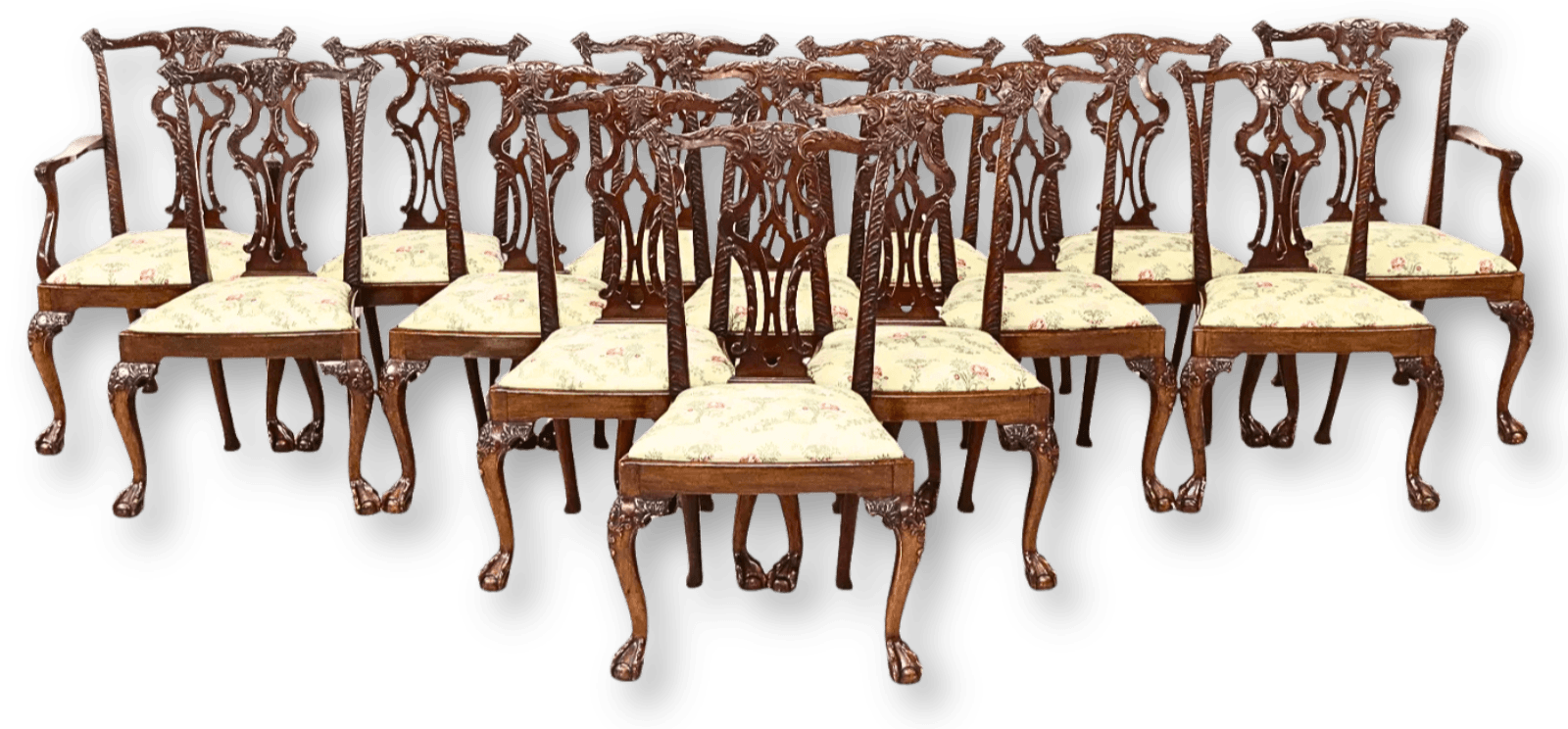
Chippendale furniture — named for London cabinetmaker Thomas Chippendale, whose 1754 pattern book defined the style — is the most collected American period furniture. Ball-and-claw feet, cabriole legs, pierced splat chair backs, and carved acanthus detail are its hallmarks. American examples from Philadelphia, Newport, Boston, and New York are among the most valuable antiques produced in this country. Austin Auction Gallery sells and appraises Chippendale furniture.
What it's worth
Signed or documented American period Chippendale pieces are among the most valuable American antiques: a Philadelphia highboy can bring $50,000–$500,000+ and signed Newport block-front pieces have sold for millions. Unsigned but attributable American pieces in original surface bring $5,000–$50,000+ depending on quality and region. English period pieces typically bring $1,000–$20,000. Quality 20th-century reproductions by Kittinger, Councill, and similar makers bring $500–$5,000 depending on quality and documentation. Colonial revival production pieces bring $200–$1,500.
Our sold results
Auction results for Chippendale
 BAKER (ATTRIB.) CHINESE CHIPPENDALE STYLE MAHOGANY BREAKFRONT DISPLAY CABINET$3,250Mar 2026
 (8) CHIPPENDALE STYLE DINING CHAIR$2,000Jul 2018
 (8) 'STATELY HOMES' CHIPPENDALE STYLE MAHOGANY DINING CHAIR$1,800Oct 2024
Showing 104 results
Auction Results
Overview & history
Thomas Chippendale published 'The Gentleman and Cabinet-Maker's Director' in 1754, and the pattern book — offering designs in the Gothic, Chinese, and Rococo tastes — was adopted by cabinetmakers on both sides of the Atlantic. English Chippendale was made primarily in mahogany with carved rococo ornament; American Chippendale adapted the style to regional materials and tastes, producing furniture that is today considered the pinnacle of American decorative arts. American regional styles differ significantly in character and value. Philadelphia Chippendale is the most elaborate and most valuable: richly carved acanthus leaves, hairy-paw feet, and the distinctive 'Philadelphia ear' on chair crest rails. Newport, Rhode Island furniture — made by the Goddard and Townsend family of cabinetmakers — is celebrated for its block-front case pieces and shell carving, and signed examples are among the most valuable American antiques in existence. Boston and Massachusetts Chippendale tends toward bombé case goods. New York Chippendale is identified by its bolder, less refined carving and often retains ball-and-claw feet with raking rear talons. The Chippendale Revival of the late 19th and early 20th centuries produced quality reproductions by makers including Kittinger, Councill, and Harden, whose labeled pieces have collector value. The style was also widely reproduced in mid-20th century 'colonial revival' furniture that, while period-appropriate in form, is clearly distinguishable from genuine 18th-century work.
Identifying & marks
Period American Chippendale shows hand-cut dovetails with slight irregularity, period-appropriate secondary woods by region (tulip poplar and yellow pine in Philadelphia; chestnut and white pine in New England; yellow pine in New York), hand-forged iron or cast brass hardware with casting seams on the back, and genuine patina on unfinished surfaces. The ball-and-claw feet should show hand-carving with slight asymmetry; machine-carved reproductions are perfectly regular. Quality reproduction makers typically stamped or labeled their pieces inside drawers. Regional attribution requires expert examination of secondary woods, construction details, and carving style.
Frequently asked
What could my Chippendale bring at auction?
Signed or documented American period Chippendale pieces are among the most valuable American antiques: a Philadelphia highboy can bring $50,000–$500,000+ and signed Newport block-front pieces have sold for millions. Unsigned but attributable American pieces in original surface bring $5,000–$50,000+ depending on quality and region. English period pieces typically bring $1,000–$20,000. Quality 20th-century reproductions by Kittinger, Councill, and similar makers bring $500–$5,000 depending on quality and documentation. Colonial revival production pieces bring $200–$1,500.
How do I identify Chippendale?
Period American Chippendale shows hand-cut dovetails with slight irregularity, period-appropriate secondary woods by region (tulip poplar and yellow pine in Philadelphia; chestnut and white pine in New England; yellow pine in New York), hand-forged iron or cast brass hardware with casting seams on the back, and genuine patina on unfinished surfaces. The ball-and-claw feet should show hand-carving with slight asymmetry; machine-carved reproductions are perfectly regular. Quality reproduction makers typically stamped or labeled their pieces inside drawers. Regional attribution requires expert examination of secondary woods, construction details, and carving style.
How do I sell my Chippendale?
Austin Auction Gallery offers free, no-obligation appraisals. Send a few photos and our specialists will tell you what it could bring at auction, then handle every step from cataloging through the sale.
What could your Chippendale bring at auction?
Our specialists provide free, no-obligation auction estimates. Send a few photos and we'll tell you what it could bring.