
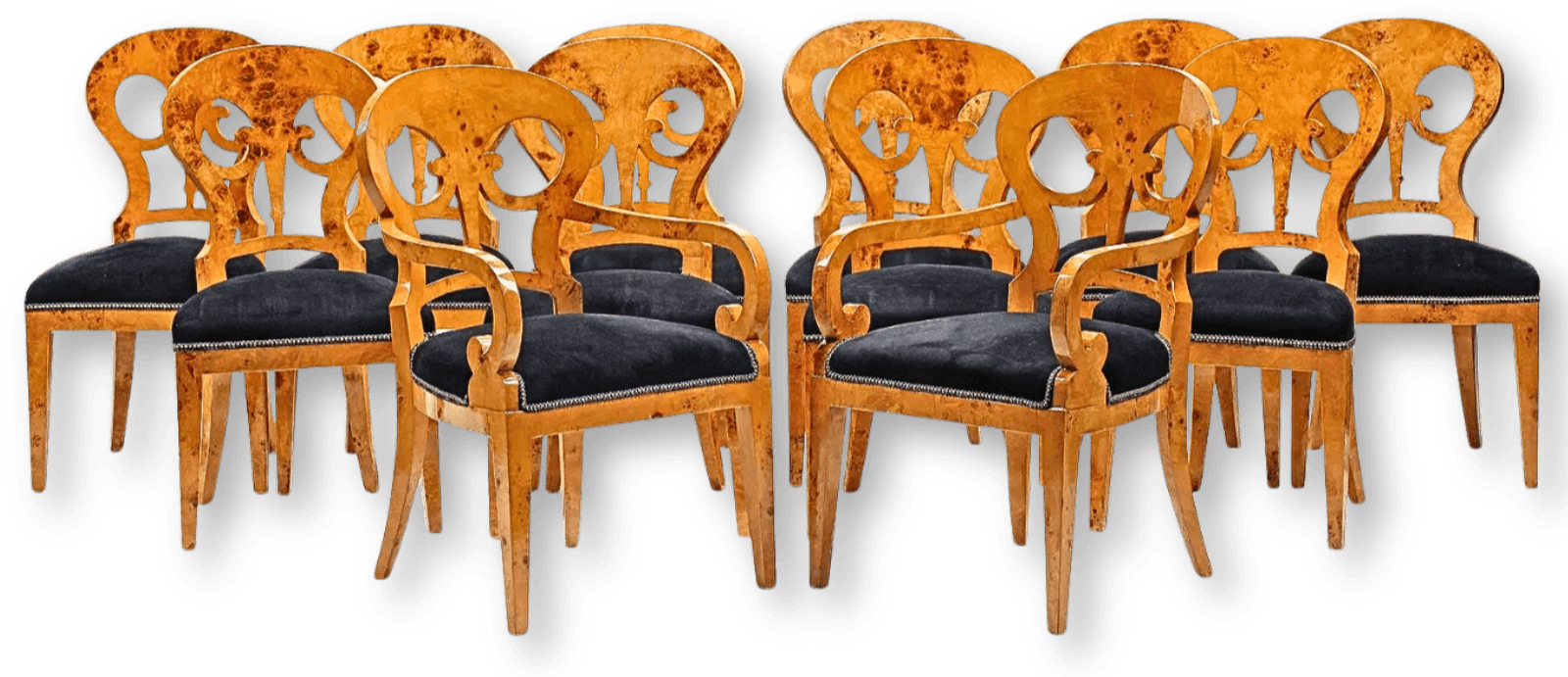
Biedermeier
Biedermeier furniture — produced in German-speaking Europe and Scandinavia from roughly 1815 to 1848 — is the middle-class counterpart to the grand Empire style: clean geometric forms, fruitwood veneers in cherry, maple, and ash, ebonized accents, and a restraint that gives the style a strikingly modern quality. Genuine period Biedermeier is actively collected worldwide. Austin Auction Gallery sells and appraises Biedermeier furniture.
What it's worth
Simple Biedermeier side chairs and occasional tables typically bring $500–$2,000 per piece. Quality case pieces — secretaries, commodes, sewing tables — in original condition with good veneer bring $2,000–$8,000. Exceptional Viennese examples with documented provenance or unusual form reach $10,000–$30,000+. Scandinavian Biedermeier generally brings somewhat less than Austrian or German examples. Condition of the veneer surface is the primary value driver; lifting, replaced, or poorly restored veneer significantly reduces value.
Our sold results
Auction results for Biedermeier
Showing 36 results
Auction Results
Overview & history
The term 'Biedermeier' derives from a satirical fictional character — 'Gottlieb Biedermeier,' a comfortably bourgeois philistine — and was applied retrospectively to the domestic culture of the German-speaking world in the years between the Congress of Vienna (1815) and the revolutions of 1848. This was an era of political conservatism and enforced domesticity in Austria and the German states, and the furniture it produced reflects those circumstances: refined but unpretentious, functional but carefully crafted, and stripped of the martial grandeur of the preceding Empire style. Biedermeier furniture is made primarily in fruitwood veneers — cherry is the most characteristic, with maple, ash, and birch also common, and walnut in southern regions. The forms are architecturally clear: secretaries with columnar pilasters, sofas with straight-legged frames and scrolled arms, commodes with simple frieze drawers, and sewing tables and work tables designed for the domestic life of the bourgeois household. Ebonized accents — ebonized feet, ebonized column shafts, ebonized banding — provide the only strong color contrast against the pale fruitwood veneers. The overall effect is one of elegant simplicity that reads as surprisingly contemporary. Scandinavian Biedermeier — particularly from Sweden and Denmark — tends toward even lighter, blonder woods and a greater austerity that amplifies the style's proto-modern qualities. Austrian Biedermeier, centered in Vienna, is the most refined and most valuable.
Identifying & marks
Authentic period Biedermeier shows fruitwood veneer over a solid wood substrate (typically pine or fir in Austrian and German examples), hand-cut dovetails, and construction appropriate to the specific country of origin. The veneer matching should be deliberate but not perfectly mechanized. Ebonized accents are typically ebonized pear or fruitwood, not painted softwood. Period hardware — round brass knobs, simple bail pulls — should show casting seams and slight irregularity. Biedermeier was rarely signed or labeled by its makers. Regional attribution is based on wood species, constructional details, and stylistic characteristics — expert assessment is recommended for significant pieces.
Frequently asked
What could my Biedermeier bring at auction?
Simple Biedermeier side chairs and occasional tables typically bring $500–$2,000 per piece. Quality case pieces — secretaries, commodes, sewing tables — in original condition with good veneer bring $2,000–$8,000. Exceptional Viennese examples with documented provenance or unusual form reach $10,000–$30,000+. Scandinavian Biedermeier generally brings somewhat less than Austrian or German examples. Condition of the veneer surface is the primary value driver; lifting, replaced, or poorly restored veneer significantly reduces value.
How do I identify Biedermeier?
Authentic period Biedermeier shows fruitwood veneer over a solid wood substrate (typically pine or fir in Austrian and German examples), hand-cut dovetails, and construction appropriate to the specific country of origin. The veneer matching should be deliberate but not perfectly mechanized. Ebonized accents are typically ebonized pear or fruitwood, not painted softwood. Period hardware — round brass knobs, simple bail pulls — should show casting seams and slight irregularity. Biedermeier was rarely signed or labeled by its makers. Regional attribution is based on wood species, constructional details, and stylistic characteristics — expert assessment is recommended for significant pieces.
How do I sell my Biedermeier?
Austin Auction Gallery offers free, no-obligation appraisals. Send a few photos and our specialists will tell you what it could bring at auction, then handle every step from cataloging through the sale.
What could your Biedermeier bring at auction?
Our specialists provide free, no-obligation auction estimates. Send a few photos and we'll tell you what it could bring.