
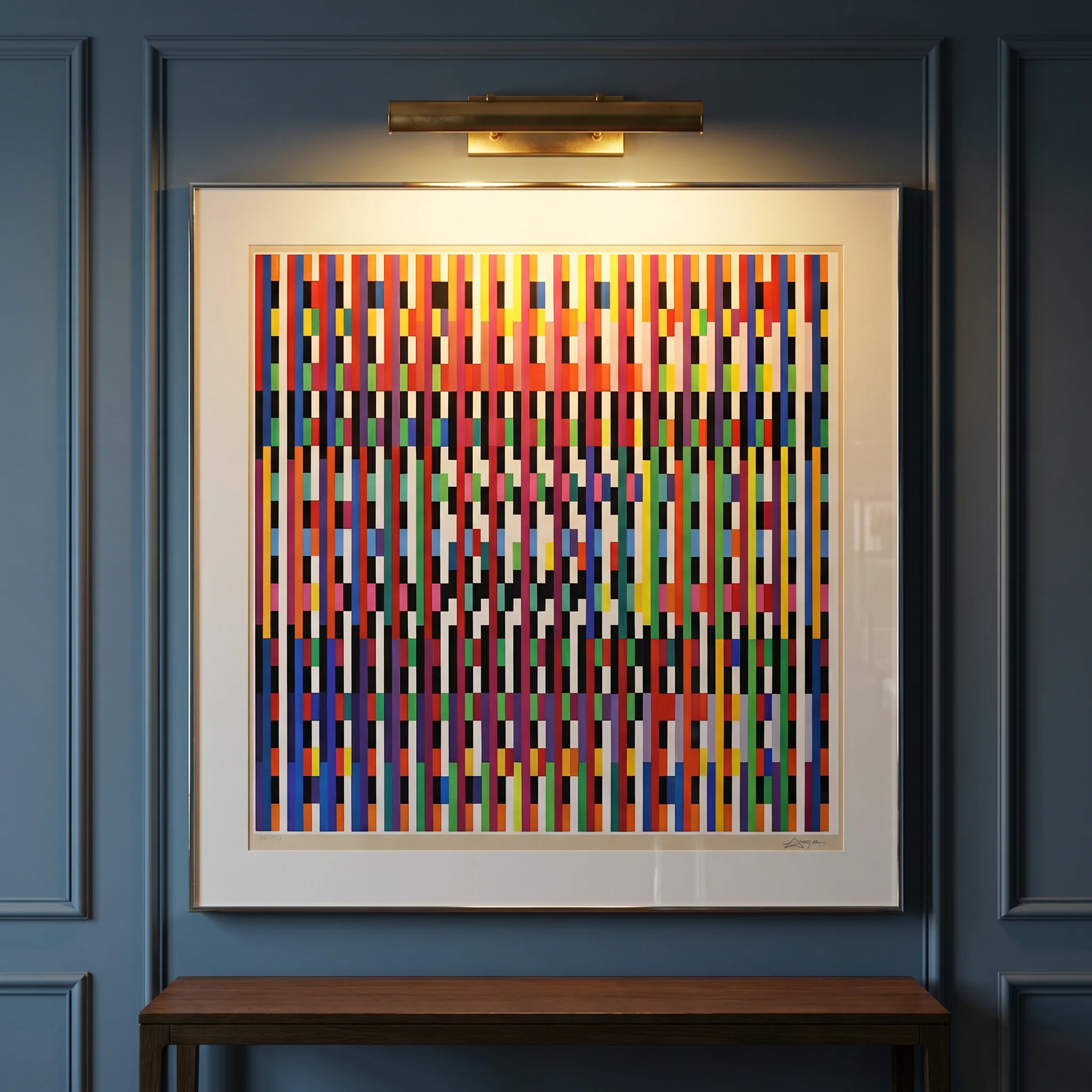
Yaacov Agam
Yaacov Agam (b. 1928) is an Israeli sculptor and Op Art pioneer, best known for kinetic and 'Agamograph' works whose imagery transforms as the viewer moves past them. His limited-edition serigraphs and Agamographs are widely collected internationally. Austin Auction Gallery sells and appraises Yaacov Agam artwork.
What it's worth
Values vary with size, subject, medium, and condition—here's what comparable pieces bring at auction.
Our sold results
Auction results for Yaacov Agam
Showing 5 results
Original Works
| Lot | Sold | Price realized |
|---|---|---|
| YAACOV AGAM (B.1928) AGAMOGRAPH SECRET FEELING II | Jul 2022 | $550 |
| YAACOV AGAM (B.1928) 'DOUBLE METAMORPHOSIS II' | Jul 2022 | $425 |
Prints & Giclées
| Lot | Sold | Price realized |
|---|---|---|
| YAACOV AGAM (ISRAELI, B.1928) OPTICAL ART COLOR SERIGRAPH, EVENING | May 2026 | $900 |
| YAACOV AGAM (B.1928) LIMITED-EDITION AGAMAGRAM PRINT, STAR OF DAVID | Jul 2024 | $425 |
| YAACOV AGAM (B.1928) SERIGRAPH 'SWIRLS' | Jul 2022 | $375 |
Overview & history
Born Yaacov Gipstein in Rishon LeZion, in what was then Mandatory Palestine, in 1928, Agam trained at the Bezalel Academy of Arts and Design in Jerusalem before studying in Zurich and settling in Paris in 1951 — the city that would remain his primary base for the rest of his career. In Paris he became associated with the Kinetic Art and Op Art movements of the 1950s and 1960s, developing a body of work centered on the idea that art should not be static but should change with the viewer's position and the passage of time, reflecting his interest in Jewish philosophical concepts of movement and transformation. Agam's signature invention is the 'Agamograph,' a technique using ridged, corrugated surfaces onto which two or more distinct images are printed, such that the viewer sees an entirely different image depending on the angle of view — a static print that behaves like a kinetic sculpture. He applied the same underlying principle to painted and sculptural works throughout his career, producing pieces that shift, transform, or appear to move as the viewer's position changes. His public sculpture commissions include the fire and water fountain at La Défense in Paris and works installed at the Israel Museum and numerous international collections. Agam's limited-edition prints and Agamographs, produced across decades in various sizes and editions, are the works most commonly found at auction, and his instantly recognizable style — geometric, brightly colored, and optically active — has made him one of the most widely collected Israeli artists internationally.
Frequently asked
How do I sell my Yaacov Agam?
Austin Auction Gallery offers free, no-obligation appraisals. Send a few photos and our specialists will tell you what it could bring at auction, then handle every step from cataloging through the sale.
What could your Yaacov Agam bring at auction?
Our specialists provide free, no-obligation auction estimates. Send a few photos and we'll tell you what it could bring.