
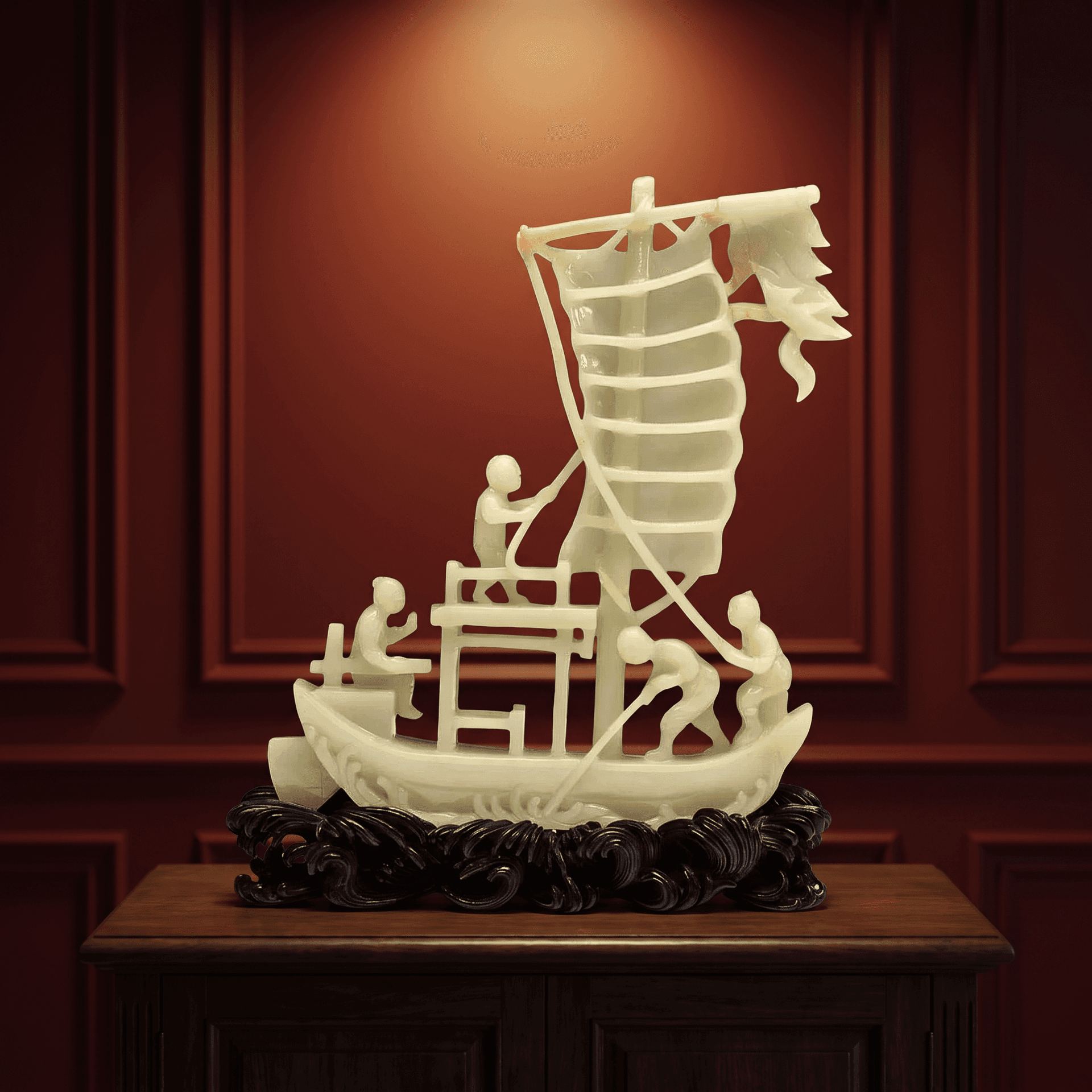
Jade & Hardstone Carvings
Jade has been the most revered material in Chinese culture for more than 5,000 years — prized above gold and more precious than diamonds in the Chinese aesthetic tradition. Carved jade figures, animals, pendants, bowls, and decorative objects appear throughout Texas estate sales, alongside a wide range of related hardstone carvings in rock crystal, rose quartz, agate, lapis lazuli, and coral. Austin Auction Gallery has sold nearly 400 jade and hardstone lots.
What it's worth
Value in jade is driven by stone quality, carving quality, age, and the specific material. Small carved figures in average-quality nephrite bring $100–$500. Quality Qing dynasty carved nephrite pieces in good white or celadon jade bring $500–$10,000 depending on size, carving quality, and jade color. Fine 'mutton fat' white nephrite carvings bring $2,000–$50,000+. Imperial green jadeite jewelry — bangles, pendants — can bring $5,000–$500,000+; fine natural imperial jadeite is one of the most valuable materials in the world. The critical caveat: the market is full of imitations. Glass, serpentine, bowenite, aventurine, and dyed quartzite are all sold as jade. Professional testing (specific gravity measurement, spectroscopic analysis) distinguishes real jade from imitations and nephrite from jadeite — a difference that can mean 10x in value.
Overview & history
In China, jade (yu) encompasses two distinct minerals: nephrite (a calcium magnesium silicate) and jadeite (a sodium aluminum silicate). Nephrite is the traditional Chinese jade — the stone used for the earliest ritual carvings dating to the Neolithic Liangzhu and Hongshan cultures (3500–2000 BCE) and for the great imperial carvings of the Ming and Qing dynasties. Nephrite ranges from white ('mutton fat' jade, the most prized) through celadon green, grey, black, and yellow-brown (often called 'russet jade' when the natural skin of the stone is incorporated into the carving). Jadeite, which comes primarily from Burma (Myanmar) and was not used in China until the late 18th century, can achieve the brilliant 'imperial green' — a translucent, vivid emerald color associated with fine jewelry — but also occurs in white, lavender, and mottled patterns. Carved jade figures and animals are the most common forms in Texas estate sales: the ubiquitous 'Buddha' or laughing Budai figure in white jade, the carved Guanyin (goddess of mercy), animal figures (rabbits, horses, fish, dragons), vases and bowls in boulder form, and the flat disc (bi) and tube (cong) forms that reference ancient ritual jade. The quality range is enormous: from small tourist-grade carvings in nephrite offcuts to major imperial-period pieces that represent the highest achievement of Chinese lapidary art. Related hardstones appear alongside jade in Chinese decorative art: rock crystal (colorless quartz), rose quartz, smoky quartz, amethyst, agate (including the banded sardonyx and carnelian used in snuff bottles), lapis lazuli, coral (red and pink, used for Buddhist prayer beads and Mandarin hat finials), turquoise, and malachite. Chinese scholars' rocks (gongshi) in naturally shaped limestone or other stone are a specialized collecting category.
Identifying & marks
Distinguishing genuine jade from imitations begins with appearance: genuine nephrite and jadeite have a distinctive waxy to vitreous luster that differs from glass (too bright and uniform) and from serpentine or bowenite (too soft-looking). Jadeite is cold to the touch and remains cool longer than glass or plastic. The 'tongue test' (genuine jade feels cool and slightly smooth) is a starting point but not definitive. Reputable dealers provide gemological laboratory reports for significant pieces; insist on one for any jadeite purchase over $1,000. Qing dynasty jade carvings can sometimes be dated by carving style — the Qianlong period produced especially fine, complex carvings with distinctive techniques — but precise dating requires specialist assessment. Reign marks or inscriptions on jade pieces add scholarly interest but must be verified.
Frequently asked
How do I know if my jade is real?
The market is full of glass, serpentine, bowenite, dyed quartzite, and other materials sold as jade. Genuine nephrite or jadeite has a distinctive cool, dense, waxy-to-vitreous feel and stays cool longer than glass or plastic. That said, visual and tactile tests alone aren't conclusive — the only certain way to confirm genuine jade, and to distinguish the more common nephrite from the more valuable jadeite, is specific gravity testing or spectroscopic analysis by a gemologist. We recommend this step for any piece you believe may be of real value.
What's the difference between nephrite and jadeite, and why does it matter for value?
Nephrite is the traditional Chinese jade used for thousands of years, ranging from white ('mutton fat,' the most prized) through celadon green, grey, and brown. Jadeite, which comes primarily from Burma and wasn't used in China until the late 18th century, can achieve a brilliant translucent 'imperial green' associated with fine jewelry. Fine imperial jadeite can be worth many times more than nephrite of similar size — a single jadeite bangle in top imperial green can be worth more than an entire collection of carved nephrite figures. Telling the two apart, and grading their quality, requires expert examination.
What other hardstones appear alongside jade in Chinese art?
Rock crystal, rose quartz, smoky quartz, amethyst, agate (including the banded stones used in snuff bottles), lapis lazuli, coral, turquoise, and malachite are all found in Chinese decorative carving. These are generally worth less than fine jade but can still carry meaningful value depending on the quality of the stone and the carving.
What is my jade carving worth?
Small carved figures in average nephrite bring $100–$500. Quality Qing dynasty carved nephrite pieces bring $500–$10,000 depending on size and jade color. Fine white 'mutton fat' nephrite carvings bring $2,000–$50,000+. Imperial green jadeite jewelry can bring $5,000 into the hundreds of thousands. Given this range, we strongly recommend an appraisal — and, for anything of potential significance, gemological testing — before selling.
What could your Jade & Hardstone Carvings bring at auction?
Our specialists provide free, no-obligation auction estimates. Send a few photos and we'll tell you what it could bring.