
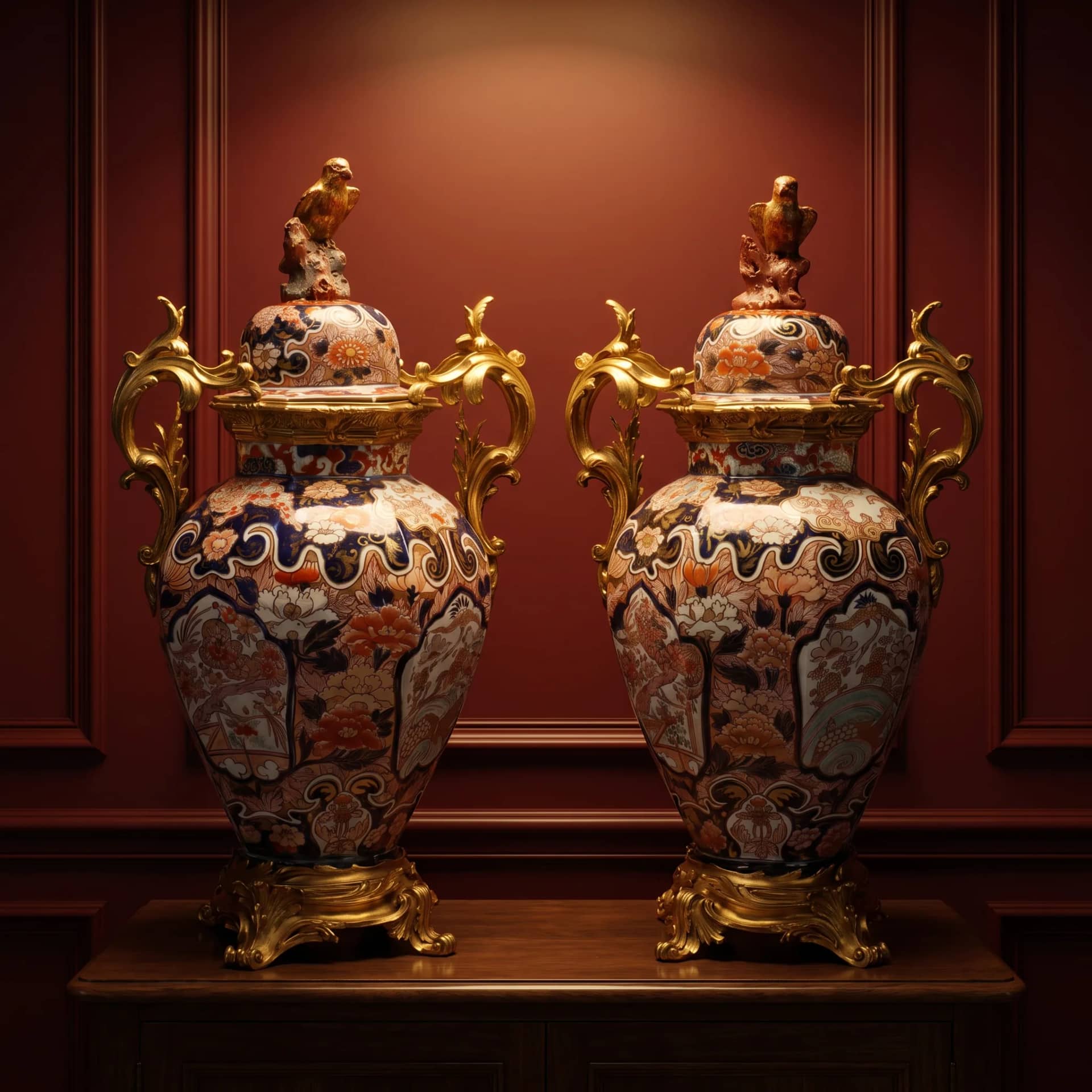
Imari Porcelain
Imari porcelain — the richly decorated cobalt blue, iron-red, and gold export ware that poured from Japan's Arita kilns beginning in the 1660s — became one of the defining luxury objects of the 18th-century Western interior. Large chargers, covered jars, and vases in the Imari palette filled the cabinets of European royalty and the homes of Texas estate collectors alike. Austin Auction Gallery has sold over 100 Imari lots.
What it's worth
Decorative 19th–20th-century Imari chargers and pieces bring $150–$800 individually. Quality 18th-century Japanese Imari pieces bring $500–$4,000. Large chargers (18 inches and above) in good condition bring $400–$2,500. Complete garnitures of three or five pieces in matched condition bring $1,500–$8,000. Genuine late 17th-century 'ko-Imari' pieces bring $1,000–$15,000+. Chinese Imari typically brings 30–50% less than comparable Japanese examples. European Imari-pattern pieces by named factories (Meissen, Worcester, Spode) are valued by the factory's own scale, not the Imari market.
Our sold results
Auction results for Imari Porcelain
Showing 31 results
Auction Results
Overview & history
Imari takes its name from the port of Imari, on Japan's Kyushu island, through which the porcelain from the nearby Arita kilns was shipped to Nagasaki and then to Europe via the Dutch East India Company beginning in the 1660s. The Arita kilns — which had learned porcelain-making from Korean potters brought to Japan after the 1590s invasions — developed the Imari palette specifically for the export market: deep underglaze cobalt blue combined with overglaze iron-red and gilding, creating a richly ornate surface that European collectors found irresistible. The Imari style spread quickly. Chinese potters at Jingdezhen, seeing the market success of Japanese Imari, began producing 'Chinese Imari' — porcelain in the same cobalt-red-gold palette made for the European market. European factories including Meissen, Worcester, and Spode also produced wares in the Imari manner. This means that identifying the origin of an 'Imari' piece requires some care — Japanese, Chinese, and European examples all exist and have different values. The forms most commonly found in Texas estate sales: large chargers (plate-form, often 12–24 inches in diameter) with paneled floral and figural designs; covered jars (the 'palace jar' form); garnitures (matched sets of three or five covered jars and vases); octagonal dishes; and ewers. Most Texas examples date from the late 18th or 19th century; genuine late 17th-century Imari ('ko-Imari' or 'old Imari') is rarer and more valuable.
Identifying & marks
Japanese Imari: look on the base for Japanese marks — fuku (good fortune) marks in underglaze blue (a common Arita export marking), Japanese characters indicating the kiln or decorator, or export markings. The clay body on genuine Japanese Imari is typically a warm off-white with a slightly grey or greyish-blue tint; Chinese Imari tends to be whiter and more refined. The painting style differs: Japanese Imari often shows a slightly freer, more irregular brushwork; Chinese Imari is more controlled and even. The 'encre de chine' style of finely drawn black-ink decoration alongside the standard palette indicates Chinese production. European Imari carries the factory's own marks (Meissen crossed swords, Worcester crescent or circle marks, etc.) and shows European construction details (English bone china body vs. hard paste).
Frequently asked
Is my Imari piece Japanese or Chinese?
Both Japan and China produced porcelain in the Imari palette (cobalt blue, iron-red, and gold) for the export market, and European factories made Imari-pattern wares too. Japanese Imari tends to have a warm, slightly grey-tinted clay body and freer brushwork; Chinese Imari is typically whiter and more evenly painted. Marks, when present, can help — Japanese pieces often carry a 'fuku' (good fortune) mark or Japanese characters, while European pieces carry their own factory marks (Meissen, Worcester, Spode, etc.). Our specialists can usually determine origin by examining the piece directly.
What's the difference in value between Japanese and Chinese Imari?
Japanese Imari generally commands a premium over comparable Chinese Imari — often 30–50% more for similar quality and age. Both are collectible, but Japanese Arita-kiln Imari is considered the original and most historically significant production. Genuine late 17th-century 'ko-Imari' (old Imari) is the most valuable of all, regardless of the general premium hierarchy.
What forms of Imari should I look for value in?
Large chargers (18 inches and up), complete garnitures (matched sets of three or five covered jars and vases), and covered 'palace jars' tend to bring the strongest prices, particularly when in good condition with no cracks or heavy wear to the gilding. Individual smaller dishes and cups are more modestly valued.
What could your Imari Porcelain bring at auction?
Our specialists provide free, no-obligation auction estimates. Send a few photos and we'll tell you what it could bring.