
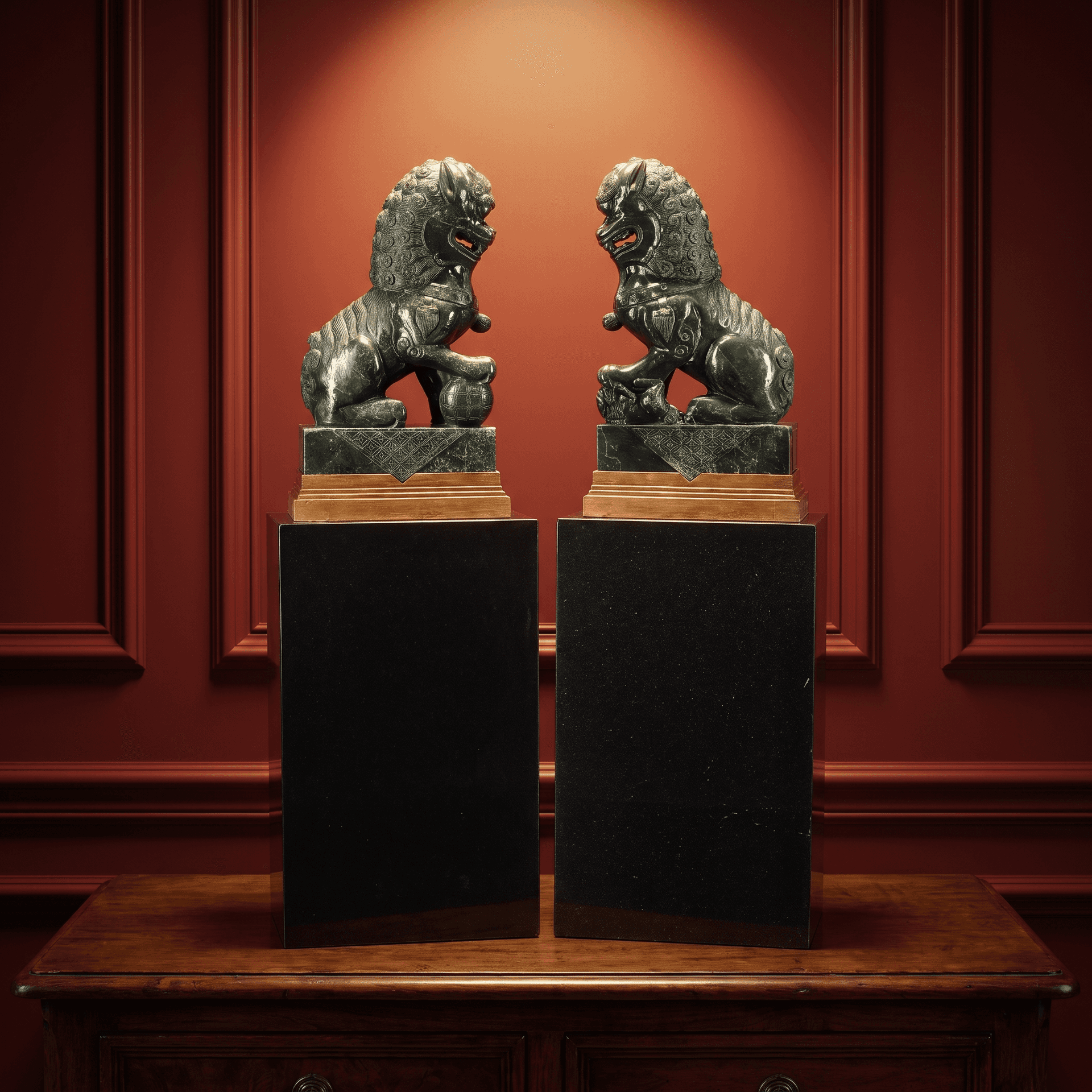
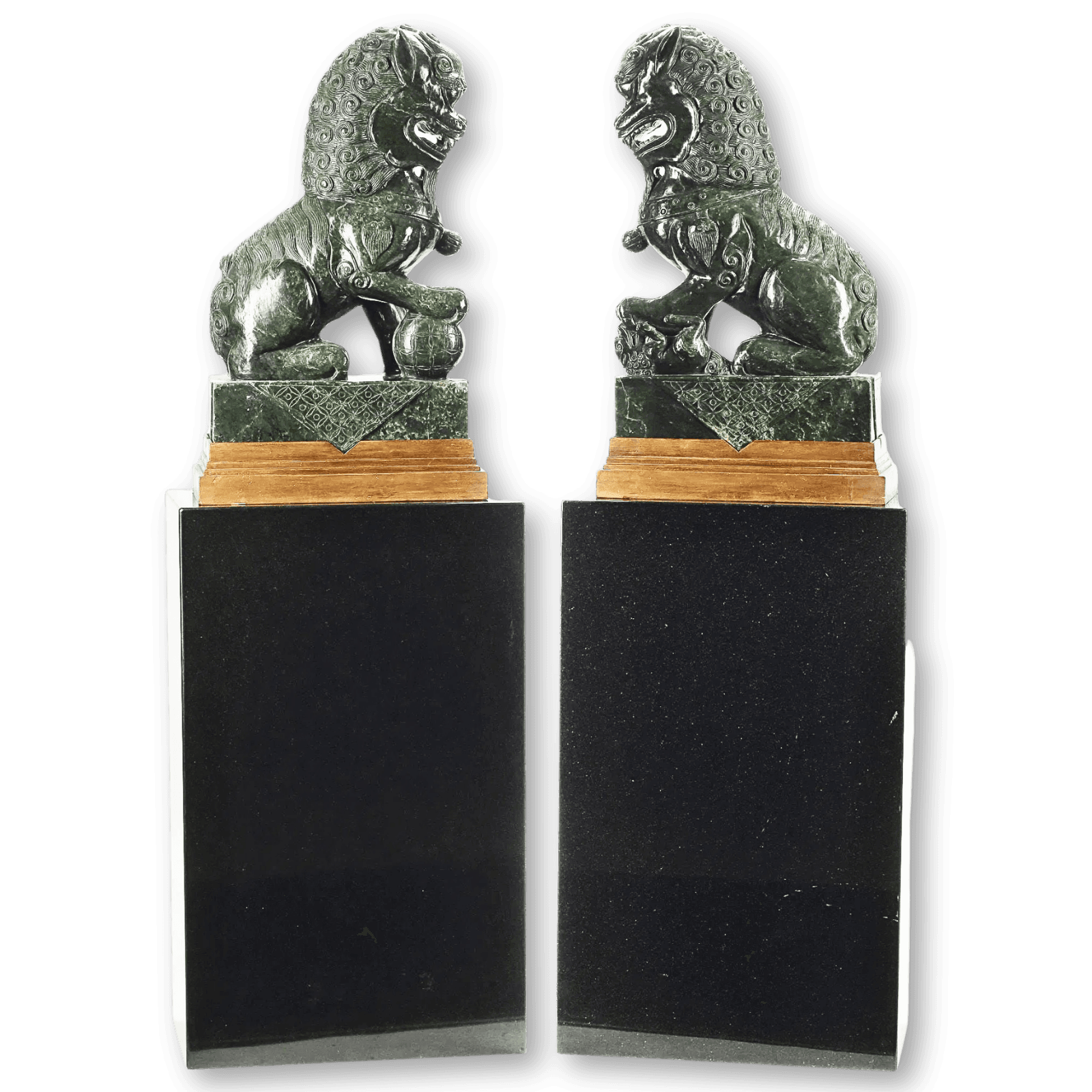
Foo Dogs/Lions
Foo dogs — known in Chinese as shishi, or guardian lions — are one of the most recognizable objects in Chinese decorative art and among the most commonly found Asian antiques in Texas estate sales. Always sold in matched pairs, they appear in porcelain, bronze, cloisonné, jade, and carved stone. Austin Auction Gallery has sold over 150 foo dog lots and appraises guardian lion pairs across all materials and periods.
What it's worth
Value depends entirely on material, period, size, and quality. Decorative 20th-century porcelain pairs in standard sizes bring $150–$600 per pair. Quality Qing dynasty porcelain pairs in iron-red and gilt or Famille Rose bring $400–$2,500. Large garden stone pairs (18–36 inches) bring $500–$4,000 depending on carving quality and stone. Bronze pairs with good patina and fine casting bring $600–$5,000+. Cloisonné pairs bring $300–$2,500 depending on quality and size. Jade or hardstone pairs are the most variable — carved white jade pairs bring $1,000–$20,000+ depending on quality of jade and carving. Always evaluate as a pair; a single piece without its partner is worth 25–40% of the pair value at best.
Our sold results
Auction results for Foo Dogs/Lions
No results sold in this period—try a wider range.
Overview & history
The shishi — the Chinese guardian lion — has protected the entrances of temples, palaces, and aristocratic homes in China for more than a thousand years. The Western term 'foo dog' (a corruption of 'Fo,' the Chinese transliteration of Buddha, with 'dog' a rough description of the creature) became standard in the English antiques trade and is the search term most collectors use today. Whatever they're called, the objects are always a matched pair: the male, with his paw resting on a decorative ball (representing sovereignty over the world), and the female, with her paw resting on a cub (representing nurturing of the next generation). Placing the male on the left and the female on the right, as viewed from inside the building looking out, is the traditional arrangement. The material range is enormous. Porcelain foo dogs — especially in iron-red (coral red) and gilt, in Chinese export blue and white, or in Famille Rose enamels — are the most common form in Texas estates. Bronze pairs, often with a patinated or gilded finish and incised detail, reflect the traditional use of metal guardian lions at palace and temple gates. Cloisonné foo dogs combine the enamel technique with the guardian form. Jade and hardstone pairs (in white jade, celadon jade, or various colored stones) represent the luxury end of the market. Carved stone pairs in limestone or marble were made for garden use and appear often in Texas garden collections. The period range is equally broad. Tang and Song dynasty examples exist in major museum collections. The most commonly encountered Texas estate examples date from the Qing dynasty (1644–1912) or the Republic period (1912–1949), with export-market examples produced for Western buyers from the 18th century onward. 20th-century decorative production in Hong Kong and mainland China supplies the majority of the decorative market.
Identifying & marks
Period Chinese porcelain foo dogs may carry reign marks on the base (Qianlong, Yongzheng, or earlier period marks), though reign marks were often applied to later pieces as a mark of respect rather than to indicate production date. Construction details confirm age: genuine Qing dynasty porcelain shows the characteristics of hand-painting, foot rim finishing, and glaze appropriate to the period. Export-market pieces may show Western-influenced design elements or rough unglazed foot rims characteristic of export production. Bronze pairs should show consistent patina and casting quality — later 20th-century bronzes often have thinner walls and less refined detail than Qing examples. For jade pairs, the key question is always whether the stone is genuine nephrite or jadeite vs. serpentine, bowenite, or glass imitation — a specialist can test with specific gravity and UV light.
Frequently asked
Why are foo dogs always sold in pairs?
Foo dogs (Chinese guardian lions, or shishi) traditionally guard an entrance as a matched male and female pair — the male with a paw on a ball representing sovereignty, the female with a paw on a cub representing nurturing. They were made and used as pairs, so a complete matched set is worth considerably more than twice the value of a single piece. If you only have one of a pair, it's still worth an appraisal, but expect it to bring meaningfully less than half of what the pair would.
What material is my foo dog pair made of, and does it matter?
Yes, significantly. Foo dogs appear in porcelain (the most common), bronze, cloisonné, carved stone (for garden use), and jade or other hardstone (the most valuable). Porcelain pairs in good condition typically bring $150–$2,500 depending on age and decoration; jade pairs can bring $1,000–$20,000+ depending on the quality of the stone and carving. Our specialists can identify the material and, for jade, determine whether it's genuine nephrite or jadeite versus a lesser stone or glass imitation.
Does a mark or reign mark on the base confirm my foo dogs are antique?
Not necessarily. Reign marks were often applied to porcelain foo dogs made well after the reign period named, as a mark of respect rather than an indication of actual production date. Age is better assessed by examining the glaze, painting style, footrim finishing, and overall construction — our specialists look at the whole piece, not just the mark.
What could your Foo Dogs/Lions bring at auction?
Our specialists provide free, no-obligation auction estimates. Send a few photos and we'll tell you what it could bring.