
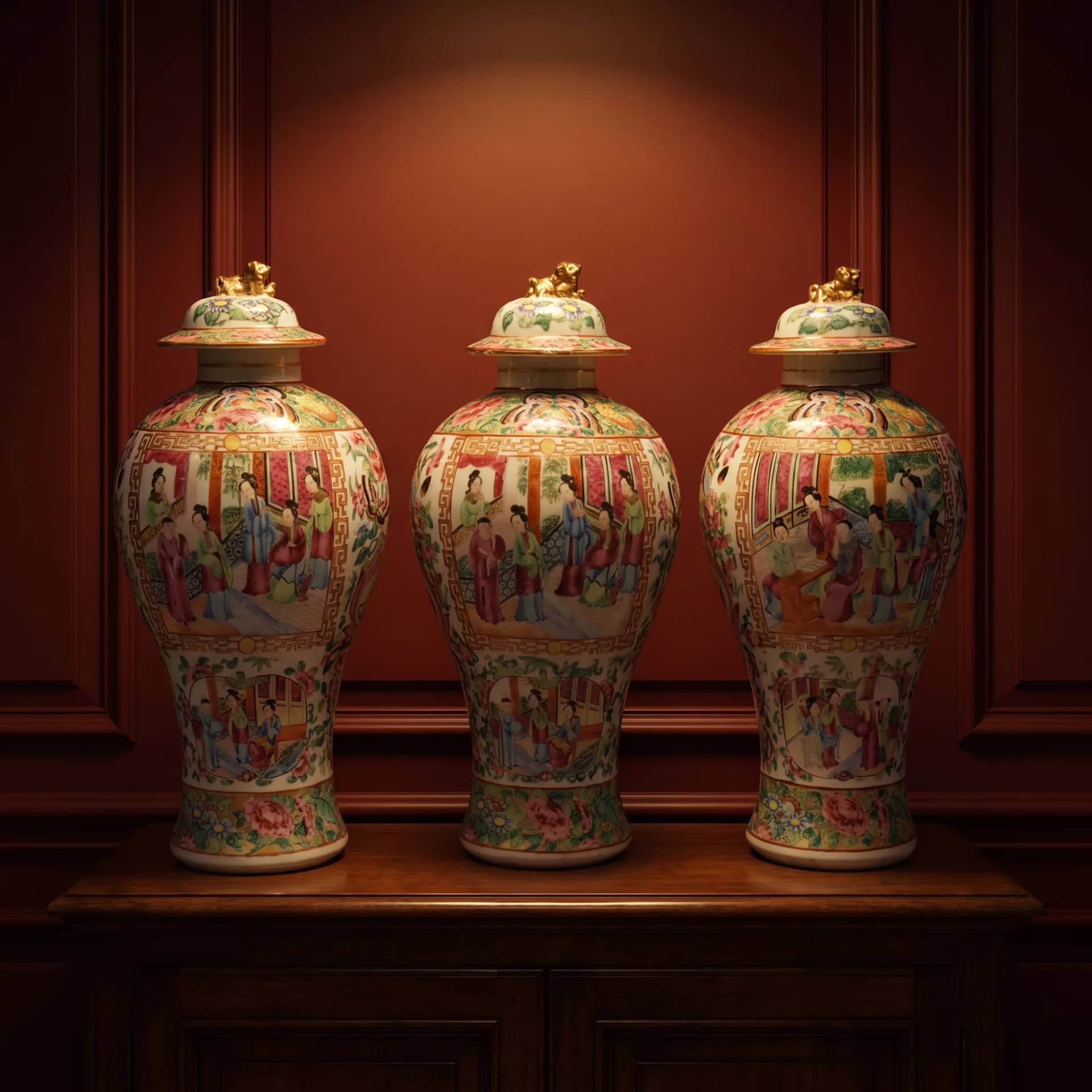
Chinese Export Porcelain
Chinese export porcelain — made at the kilns of Jingdezhen and decorated in Guangzhou (Canton) specifically for the Western market — poured into European and American homes from the 17th century onward. Canton ware, Rose Medallion, Fitzhugh, and custom armorial porcelain are the major categories. These are among the most commonly found antique Chinese ceramics in Texas estate sales. Austin Auction Gallery has sold nearly 200 Chinese export porcelain lots.
What it's worth
Canton ware individual serving pieces (platters, vegetable dishes) bring $100–$500 depending on size and condition. Complete Canton dinner services in good condition bring $1,500–$6,000. Rose Medallion serving pieces bring $100–$600 individually; complete services bring $1,500–$5,000. Large Canton soup tureens in good condition bring $400–$1,500. Fitzhugh pattern pieces in standard colors bring $200–$1,000 individually, with orange and brown Fitzhugh rarer than blue. Armorial porcelain with documented family history brings $500–$5,000+ depending on the family, the period, and the form. Condition is critical: chips and repairs significantly reduce value, especially on Canton and Rose Medallion.
Our sold results
Auction results for Chinese Export Porcelain
Showing 25 results
Auction Results
Overview & history
From the late 16th century through the early 20th century, the kilns of Jingdezhen produced porcelain specifically shaped to Western tastes and decorated by artists in Guangzhou (Canton) with the patterns and subjects that European and American buyers wanted. The export trade, dominated first by the Portuguese, then the Dutch (VOC) and English (East India Company), and later by American clipper ships, moved millions of pieces of porcelain to Western markets and created the distinctive 'China Trade' aesthetic that blended Chinese technique with Western form. Canton ware — the blue-and-white export porcelain decorated with characteristic scenes of a landscape with figures, boats, bridges, and willow trees — is the most commonly found Chinese export porcelain in American estates. Made from the late 18th through the early 20th century, Canton appears as platters, vegetable dishes, soup tureens, sauce boats, and full dinner services. Rose Medallion — the polychrome enamel export ware with alternating panels of figures in court dress and panels of flowers and birds — is equally common and was the fashionable Chinese porcelain in American homes from the 1840s through the early 20th century. Fitzhugh pattern (a geometric border of butterflies, flowers, and trellis, surrounding a central medallion) was made in blue, orange, green, and brown and is particularly prized by American collectors because of its historical association with the China Trade. Armorial porcelain — made to order with European or American families' coats of arms — is the rarest and most historically significant category: pieces traceable to specific families with documented coats of arms carry strong premiums.
Identifying & marks
Canton ware is identified by its characteristic blue-and-white landscape decoration — the same scene repeated on every piece, with boats, figures, bridges, trees, and islands — applied to standard Western serving forms. Early (pre-1850) Canton shows hand-painted brushwork with more character and variation; later pieces show increased standardization. Rose Medallion is identified by its polychrome palette (green, pink, gold, white) and the alternating panel decoration. Fitzhugh is identified by its characteristic geometric border regardless of color. Armorial pieces carry the coat of arms in the center; identifying the family often requires heraldic research. Most export porcelain is unmarked or carries simple export marks rather than reign marks.
Frequently asked
What's the difference between Canton ware and Rose Medallion?
Both are Chinese export porcelain patterns made for the Western market, but they look quite different. Canton is blue-and-white, decorated with a repeating landscape scene of boats, bridges, and willow trees. Rose Medallion is a polychrome pattern (pink, green, gold, white) with alternating panels of figures in court dress and panels of flowers and birds. Both were popular in American homes from the 18th through early 20th centuries and appear regularly in Texas estates, often as part of larger dinner services.
I have a partial set of Canton or Rose Medallion — is it still worth selling?
Yes. While complete matched dinner services command the strongest prices ($1,500–$6,000 for a full Canton service, for example), individual serving pieces like platters, tureens, and vegetable dishes are also collected and traded on their own, typically bringing $100–$500 each depending on size, pattern, and condition.
What is armorial porcelain, and is mine more valuable because of the crest?
Armorial porcelain was custom-ordered by wealthy Western families, painted with their coat of arms in the center of the piece. It's the rarest and often the most historically interesting category of Chinese export ware. If your piece carries a family crest, it may be more valuable — particularly if the family can be identified through heraldic research. Bring it in or send photographs and our specialists can help research the crest and assess value.
What could your Chinese Export Porcelain bring at auction?
Our specialists provide free, no-obligation auction estimates. Send a few photos and we'll tell you what it could bring.