
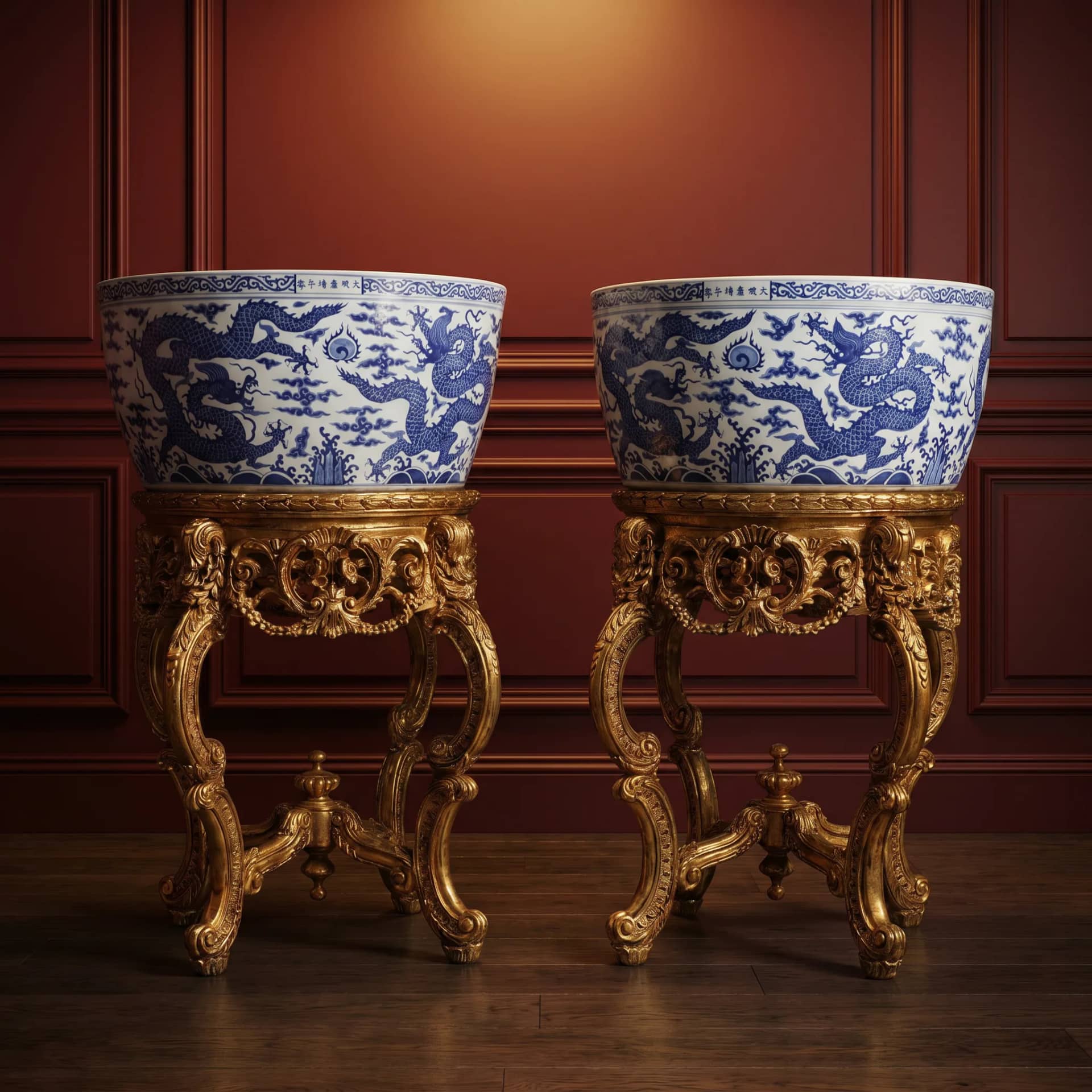
Chinese Blue & White Porcelain
Chinese blue and white porcelain — cobalt-blue underglaze painting on a white ground — is the most recognizable and most widely collected of all Chinese ceramics. From the Yuan dynasty origins through the great imperial productions of the Ming and Qing kilns to the export wares that crossed every ocean, blue and white has defined Chinese porcelain for 700 years. Austin Auction Gallery has sold nearly 200 Chinese blue and white lots.
What it's worth
Decorative blue and white pieces from the 20th century — ginger jars, vases, chargers in standard sizes — bring $100–$600 individually. Quality late Qing period pieces with fine painting and appropriate construction bring $400–$3,000. Genuine Kangxi period pieces in good condition bring $1,000–$15,000. Genuine Ming dynasty pieces bring $3,000–$100,000+ depending on the reign period, form, and condition. Exceptional imperial examples with documented provenance from major collections bring multiples of these figures. Garden seats in good condition bring $300–$2,500 per pair; single seats bring less.
Our sold results
Auction results for Chinese Blue & White Porcelain
 CHINESE BLUE & WHITE VASE, POSSIBLY QIANLONG$5,500Apr 2017
 (2) CHINESE BLUE & WHITE PORCELAIN FISH BOWLS ON GILT STANDS$5,500Mar 2025
 LARGE CHINESE BLUE & WHITE PORCELAIN CHARGER$5,500May 2023
Showing 139 results
Auction Results
Overview & history
Blue and white porcelain was developed at the Jingdezhen kilns during the Yuan dynasty (1271–1368), when Mongol patronage and Middle Eastern cobalt combined with Chinese ceramic skill to create a new decorative vocabulary. The technique — painting with cobalt oxide directly on the unfired porcelain body, then covering with a clear glaze and firing at high temperature — produced the characteristic vivid blue against a clean white ground that would become the dominant Chinese export ceramic for the next six centuries. The great periods of blue and white production are the Ming dynasty (1368–1644) and the Qing dynasty (1644–1912). Ming blue and white — particularly from the Xuande (1426–1435) and Chenghua (1465–1487) periods — is considered the pinnacle of the form: a subtle, slightly 'heaped and piled' cobalt blue with a lively, sketchy painting style that differs markedly from the more controlled Qing productions. Qing blue and white, especially from the Kangxi (1661–1722) period, is celebrated for its brilliant sapphire-blue cobalt and precise, detailed painting. The Qianlong (1736–1795) period produced vast quantities of export ware. In Texas estates, the most commonly found Chinese blue and white pieces are: ginger jars (covered spherical jars) in a range of sizes and quality levels; baluster vases; chargers and large dishes; lidded boxes; Canton export wares; and the characteristic blue and white garden seats (barrel-form stools). The majority date from the late Qing period, the Republic period (1912–1949), or from 20th-century production in China and Hong Kong for the export decorating market.
Identifying & marks
Period identification in Chinese blue and white relies on several factors working together: the quality and color of the cobalt blue (Ming blue has a characteristic slightly 'inky' or 'heaped-and-piled' quality; early Qing Kangxi blue is brilliantly clear sapphire; later Qing blue can be purplish or grey); the clay body and footrim finishing (period pieces show appropriate footrim characteristics for their era); and the painting style. Reign marks help date pieces but must be read with caution — the practice of applying earlier reign marks (especially Chenghua and Xuande) to later pieces was widespread from the Jiajing period onward. A Qianlong mark does not guarantee a Qianlong-period piece; nor does an absence of mark indicate a pre-Ming piece. Heavy pieces with thick walls and rough footrims are likely later; light, well-finished pieces with appropriate blue quality may be earlier.
Frequently asked
How can I tell if my blue and white piece is Ming, Qing, or later?
Several clues work together: the color and quality of the cobalt (Ming blue often has a slightly 'heaped and piled' inky quality; Kangxi-period blue is brilliantly clear; later Qing blue can look purplish or grey), the painting style (freer and more sketchy on early pieces, more controlled on later ones), and the footrim and clay body. Reign marks can mislead, since earlier marks were often copied onto later pieces. Because these details require careful side-by-side comparison, we recommend an in-person or photo assessment by our specialists rather than guessing from the mark alone.
What forms of blue and white porcelain are most common in estates?
The most frequently seen forms are ginger jars (covered spherical jars), baluster vases, large chargers and dishes, lidded boxes, and garden seats (barrel-form stools). Most pieces found in Texas estates date from the late Qing dynasty, the Republic period (1912–1949), or 20th-century production made for the export decorating market.
Are Chinese blue and white garden seats valuable?
Yes, particularly as a matched pair. Garden seats in good condition (no cracks and with even coloring) typically bring $300–$2,500 per pair; single seats bring considerably less. Quality of the painting and the period of manufacture both affect value.
What could your Chinese Blue & White Porcelain bring at auction?
Our specialists provide free, no-obligation auction estimates. Send a few photos and we'll tell you what it could bring.